

Article Highlights
- Skipping technical discovery can increase total development spending by 40-60%, compared with investing 5-10% of the budget upfront in scoping.
- Roughly 50% of software rework is directly connected to poorly gathered requirements.
- Legacy and third-party integrations that are not assessed during discovery can consume 20-30% of the total budget through unplanned work.
- 52.7% of software projects exceed their budget or timeline, or deliver less than expected. Many of these risks can be identified during discovery.
- A requirement corrected during active development costs considerably more than the same correction made during planning.
Companies that skip technical discovery spend 40-60% more on development than teams that invest 5-10% of the budget upfront in scoping. Half of all software rework can be traced to poorly gathered requirements. Industry-wide, 52.7% of software projects end up over budget, delayed, or unable to deliver the expected outcome, while 31.1% never reach production. These results often point to gaps in discovery rather than limitations in the technology itself.
This article explains what a technical discovery phase should assess before production development begins. It covers technical feasibility, integrations, risks, scope, architecture, expected deliverables, common mistakes, and the decisions a team should make before committing budget and resources to a new product idea.
Why Discovery Decides the Project’s Direction
Technical discovery is the stage where most project risks are identified or missed. Unclear requirements, poor communication, and weak scope control can create more problems than technical complexity. For this reason, discovery and scoping require the same attention as the choice of technology stack.
A complete discovery phase should produce concrete outputs that stakeholders can review. These usually include a feasibility analysis, an architecture direction, a risk matrix, and a go or no-go recommendation. A presentation alone is not enough to guide development decisions.
What a Technical Discovery Should Cover
1. Technical Feasibility
The team must determine whether the proposed product can run on the current technology stack or requires new technologies. This assessment includes integration compatibility with existing legacy systems and an honest review of where the team’s experience does not cover the proposed architecture.
2. Integration Complexity
Every API, legacy system, payment provider, and CRM or ERP dependency should be identified before estimation begins. Complex integrations discovered during development are among the most common sources of the 20-30% budget overruns that technical discovery is meant to prevent.
3. Risk Assessment
A complete discovery phase separates technical risks, such as unproven technology and complex integrations, from market risks, such as insufficient demand or regulatory barriers, and resource risks, including talent gaps and timeline conflicts. These findings should inform a clear go or no-go decision matrix rather than remain a general list of concerns.
4. Scope and Architecture Definition
At this stage, the team documents the Software Requirements Specification, selected technology stack, and MVP definition in enough detail to support a meaningful estimate. Project goals should be measurable and time-bound.
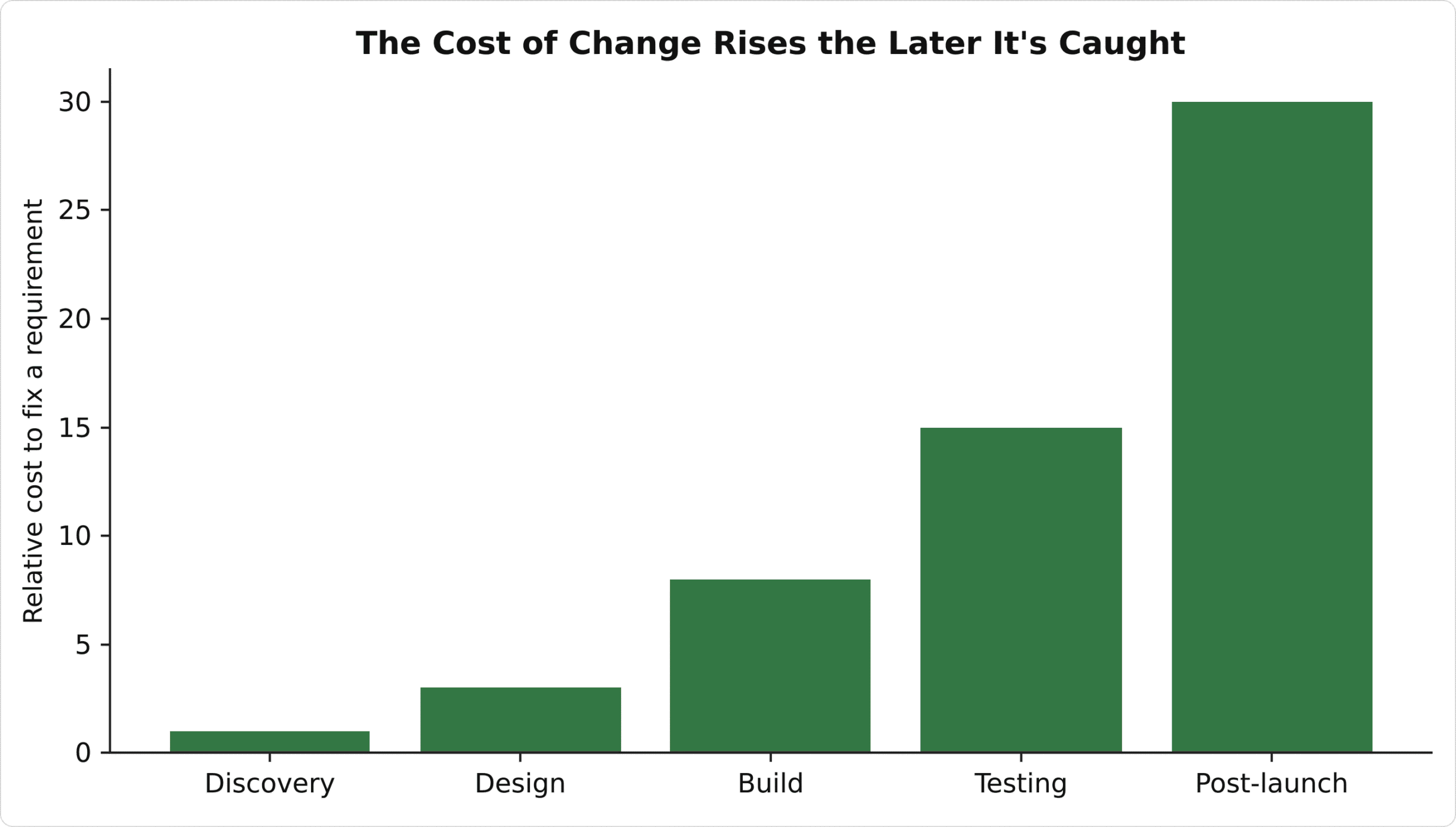
Image 1. The cost of fixing a missed requirement rises sharply the later it’s caught.
Discovery Phase Deliverables
The value of technical discovery depends on the decisions and documentation it produces. The table below summarizes the main deliverables, the questions each one answers, and its role in reducing project uncertainty before development begins.
| Deliverable | What It Answers | Why It Matters |
|---|---|---|
| Feasibility analysis | Can this be built with current or planned tech, at reasonable cost? | Prevents committing to an architecture the team can’t support |
| Architecture & tech stack decision | What will this run on, and why? | Sets the foundation every later estimate depends on |
| Integration map | What systems, APIs, and data sources does this touch? | Surfaces the 20–30% budget risk hiding in “just connect it to X” |
| Risk matrix | What could kill this — technically, commercially, or organizationally? | Turns vague worry into a go/no-go decision |
| MVP definition & roadmap | What ships first, and in what order? | Keeps scope honest and estimation grounded in reality |

Benefits and Common Pitfalls
Benefits
Estimates you can trust: An estimate based on a defined architecture and integration map is more reliable than one based on a short project brief.
Fewer expensive surprises: Integration and legacy system risks are identified during planning instead of several sprints into development.
A clear go or no-go decision: In some cases, the most valuable outcome of technical discovery is learning early that the idea or proposed approach needs to change before development starts.
Proven scoping experience: TechBar’s engineers run discovery across SaaS, FinTech, and HealthTech products, see who we are.
Treat discovery outputs as real project deliverables. The SRS, architecture decision record, and risk matrix should document what was decided and why.
Discovery should remain focused. Its purpose is to reduce the most significant risks, not remove every uncertainty. A phase that continues for months can become a budget risk itself.
A requirement changed during active development costs much more to address than the same issue corrected during planning. Discovery is the least expensive stage at which a team can identify an incorrect assumption.
Common Pitfalls
Skipping discovery to save time: The 40-60% cost increase associated with skipping it often begins to appear during the first development sprints.
Treating discovery as a sales activity: A phase led only to close a deal is likely to produce a proposal instead of a technically grounded scope and architecture.
Ignoring legacy integration scope: This is one of the most common sources of large, unplanned costs.
Leaving out a go or no-go decision: Discovery should assess whether the project is ready to proceed. A process that always recommends development is not evaluating risk objectively.
The Technical Discovery Checklist
- Define the problem and goals in specific, measurable, and time-bound terms.
- Assess technical feasibility against the current or planned technology stack, including gaps in team experience.
- Map every integration point, including APIs, legacy systems, payment providers, and CRM or ERP dependencies.
- Build a risk matrix covering technical, market, and resource risks, with a clear go or no-go recommendation.
- Write a Software Requirements Specification covering the architecture, technology stack, and core data flows.
- Define the MVP scope explicitly, including what will be delivered first and what will be deferred.
- Confirm the team composition needed for delivery. TechBar’s staff augmentation model and talent pool can provide vetted engineers for a defined build within 1-2 weeks.
“The projects that blow their budget almost never fail on the technology. They fail on the integration nobody scoped and the requirement nobody wrote down.”
– Dmytro Barbashov, CTO, TechBar
Key Takeaways
The difference between a project that stays within its budget and one that exceeds it by 45% or more can often be traced to the questions answered during discovery. A complete technical discovery phase gives the team the information needed to evaluate feasibility, define scope, expose integration risks, and decide whether the product is ready for development.
TechBar’s Software Product Engineering team conducts technical discovery before committing to an estimate and can provide senior nearshore engineers once the scope is clear. Contact our team to discuss the technical scope of your next product idea.

Dmytro Barbashov CTO
FAQs
-
How long should a technical discovery phase take?
The duration depends on the product scope, number of integrations, architecture complexity, and availability of stakeholders. A focused product discovery can take several weeks. More complex platforms with legacy systems, regulated data, or multiple business units require additional time. The phase should end when the team has enough evidence to define scope, estimate the work, and make a go or no-go decision.
-
Can technical discovery be useful if the product idea has already been validated?
Yes. Market validation confirms that a relevant problem and potential demand exist. Technical discovery examines whether the proposed solution can be built within the available budget, timeline, security requirements, and existing technology environment. Both forms of validation address different project risks.
-
Who should participate in technical discovery?
The core group usually includes a product owner or business stakeholder, a solution architect or senior engineer, a product or business analyst, and a UX specialist when user flows are part of the scope. Security, data, compliance, and infrastructure specialists should join when their areas affect key decisions.
-
What happens if discovery shows that the original plan is too risky?
The team can reduce the MVP scope, change the architecture, replace an unsuitable integration, test a technical assumption through a proof of concept, or pause the project. Identifying these issues before development protects the budget and gives stakeholders time to choose a more realistic path.