
Article Highlights
- Lack of market need accounts for roughly 42% of startup failures, making it the most common cause cited in the study.
- A CB Insights study found that failed startups had raised a median of $11 million in equity before shutting down. Funding alone could not compensate for insufficient evidence of demand.
- Assumption mapping separates ideas that could undermine the product from those that do not require immediate attention through a simple importance-versus-evidence grid.
- Smoke tests, including landing pages, ads, and sign-up forms, can measure genuine demand before production code is written.
- An idea validation framework tests four areas in sequence: problem existence, willingness to pay, solution fit, and business model viability.
Lack of market need accounts for roughly 42% of startup failures, more than running out of cash, team conflict, or poor timing. In one CB Insights study of 431 failed companies, the median team had raised $11 million before shutting down. These companies had funding, but they lacked evidence that enough people wanted what they were building.
Validation is an essential part of product development. An idea validation framework helps teams identify weak assumptions before significant time and budget are committed to development.
Why Validation Is Cheaper Than Building
Every assumption within a product idea is a bet. Some are relatively safe. For example, teams rarely need to prove that users prefer a faster page load. Others can determine the future of the product: Will customers pay for it? Does the problem exist at the expected scale? Is the proposed solution suitable for the way customers already work?
The costly mistake is developing the complete product before testing these critical assumptions. A structured idea validation framework allows the team to design the least expensive credible experiment that could disprove an assumption before the cost of changing direction increases.
What to Test, in Order
1. Problem Existence
First, confirm that the problem exists at the scale the business assumes. Market research, customer interviews, and analysis of relevant communities or forums can reveal how frequently the problem occurs, who experiences it, and how they currently address it.
If the problem is real but limited to a narrow audience, the result affects the product scope, market size, and amount of investment that can be justified.
2. Willingness to Pay
A problem people experience is different from one they will pay to solve. Smoke tests, pre-sales, and letters of intent measure genuine willingness to pay before development begins. These actions provide stronger evidence than a user saying they would use the product during an interview.
3. Solution Fit
After confirming the problem and willingness to pay, test the proposed solution. Clickable prototypes, concierge tests, and structured user feedback can show how well the product fits existing workflows and gives users the expected result.
A concierge test delivers the intended value manually before the team invests in automating the process. This helps separate interest in the outcome from interest in a specific interface or technical implementation.
4. Business Model Viability
The final stage of the idea validation framework examines the unit economics at the price and volume suggested by earlier tests. A confirmed problem and clear willingness to pay can still result in an unsustainable product when the cost of acquiring and serving a customer exceeds the expected revenue.
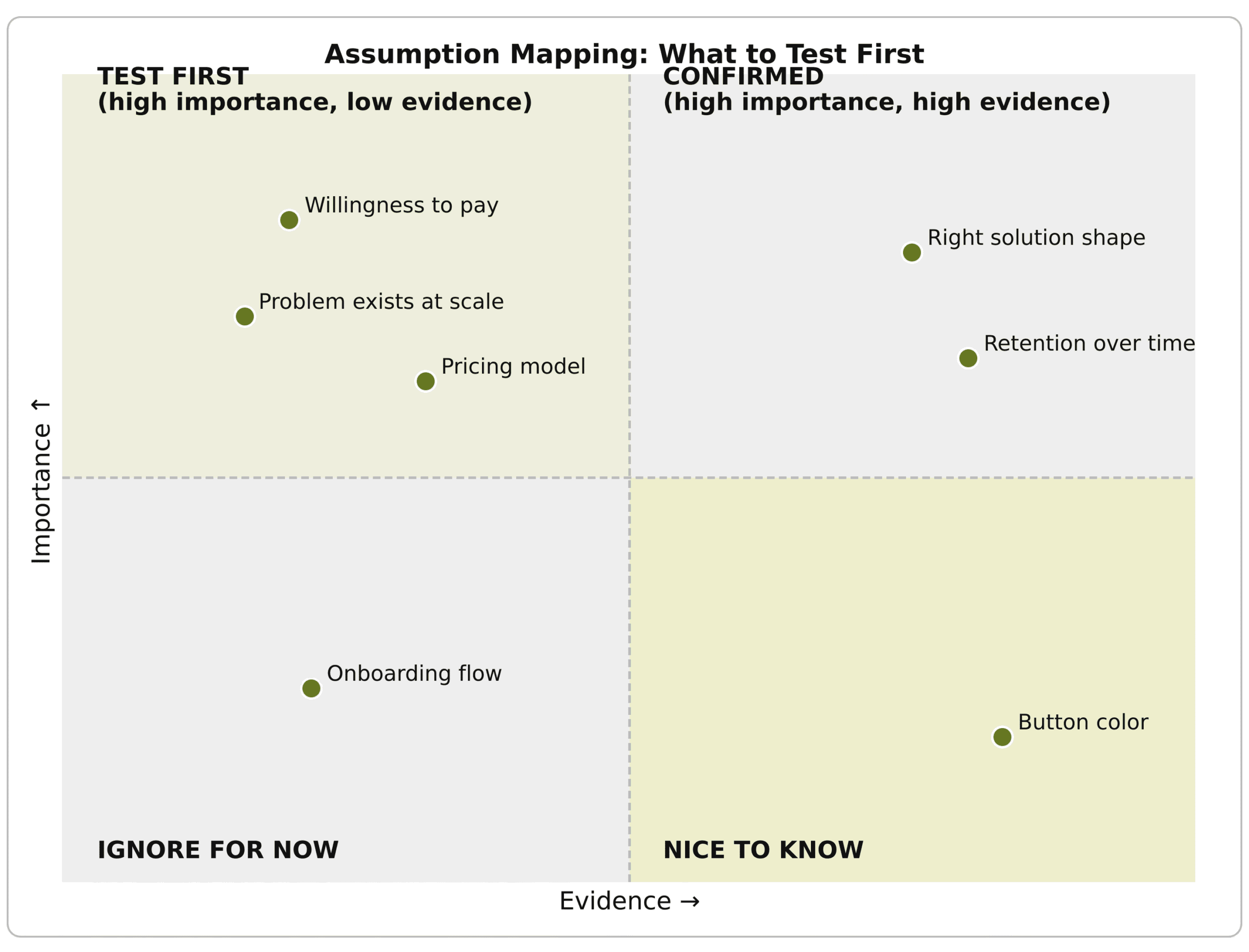
Image 1. Test the assumptions in the high-importance, low-evidence quadrant first, they’re the ones that could kill the idea.
Validation Methods Compared
| Method | What It Tests | Cost / Speed | Best For |
|---|---|---|---|
| Customer interviews | Problem existence and framing | Low cost, fast | Early-stage, before any building |
| Landing page smoke test | Willingness to engage or sign up | Low cost, fast | Measuring interest before development |
| Pre-sale or letter of intent | Willingness to actually pay | Low-medium cost, medium speed | B2B or high-ticket products |
| Concierge MVP | Solution fit, manually delivered | Medium cost, medium speed | Validating the “how” before automating it |
| Clickable prototype | Usability and solution fit | Low-medium cost, fast | Refining UX before committing engineering time |
Test the assumptions in the high-importance, low-evidence quadrant first. These are the assumptions most likely to undermine the idea if they prove false.

Benefits and Common Pitfalls
Benefits
Spend engineering budget on validated bets. Every dollar spent building a solution to a confirmed problem is safer than a dollar spent on a guess.
Faster path to product-market fit. Testing solution fit before a full build means fewer expensive pivots after launch.
A defensible story for investors or stakeholders. Evidence from real experiments is a stronger case than conviction alone.
Execution-ready once validated. TechBar’s Software Product Engineering team can move from validated concept to MVP quickly once the risky assumptions are cleared.
Prioritize assumptions using the importance-versus-evidence grid. The ones that are both critical to success and poorly understood, the “leap-of-faith” assumptions, get tested first, before anything else.
A user saying “yes, I’d use that” in an interview is not validation. Only a real behavior, money changing hands, a genuine sign-up, time actually spent, is reliable evidence of demand.
Validation doesn’t stop after the MVP ships. New assumptions appear at every stage of growth, and the same testing discipline applies to feature bets, not just the original idea.
Common Pitfalls
Testing with friends and family. They’re motivated to be encouraging, not honest, which defeats the purpose of the test.
Asking hypothetical questions. “Would you use this?” gets a different answer than an actual sign-up or payment does.
Skipping the willingness-to-pay test. Confirming a problem exists isn’t the same as confirming anyone will pay to solve it.
Validating once and building forever. Treating validation as a single gate at the start, instead of an ongoing discipline, misses new assumptions introduced by every later decision.
The Idea Validation Checklist
- Write down every core assumption behind the idea: who the customer is, what problem they have, what they’ll pay, and how they’ll access it.
- Plot each assumption on an importance-versus-evidence grid to find the leap-of-faith ones.
- Design the cheapest possible experiment for each high-priority assumption: interview, smoke test, concierge test, or pre-sale.
- Run the problem-existence test before building anything.
- Run a genuine willingness-to-pay test, not just an interest survey.
- Test solution fit with a prototype or concierge MVP before committing full engineering resources.
- Confirm unit economics work before scaling and bring in execution capacity once validated, via TechBar’s staff augmentation and talent pool.
“The founders who get in trouble aren’t the ones who guessed wrong. They’re the ones who never actually tested the guess before building around it.”
– Bohdan Steblianko, CEO, TechBar
Key Takeaways
Startups that run out of money often fail after investing in a product without first testing the assumptions that could have changed the decision to build it. An idea validation framework helps teams map those assumptions, test the highest-risk ones first, and use observed behavior to decide what should move into development.
TechBar’s Software Product Engineering team helps validate the idea and, once it holds up, builds the MVP with senior nearshore engineers. Talk to our team about what to test before you build.

Bohdan Steblianko CEO
FAQs
-
How do you validate an idea when the product does not exist yet?
Start with the assumptions that carry the greatest business risk, such as the urgency of the problem, target users’ current alternatives, willingness to pay, and expected acquisition channels. An idea validation framework helps convert these assumptions into testable hypotheses that can be checked through interviews, landing pages, prototypes, pre-orders, or small-scale experiments.
-
How many customer interviews are enough for idea validation?
There is no fixed number that applies to every idea. Early patterns often become visible after 10–15 well-targeted interviews, but the quality of participant selection matters more than the total. Interviews should continue until responses become repetitive and the team can clearly explain the problem, current alternatives, decision criteria, and barriers to adoption.
-
What evidence shows that an idea is ready for development?
Positive feedback alone is insufficient. Stronger evidence includes users taking a meaningful action, such as joining a waiting list, requesting a pilot, sharing relevant data, committing internal resources, or agreeing to pay. Before development begins, the team should also confirm technical feasibility, market fit, expected costs, and measurable success criteria.
-
Can an idea pass customer validation but still fail as a business?
Yes. Customers can confirm that a problem exists while the proposed solution remains too expensive to deliver, difficult to distribute, restricted by regulations, or unable to generate sufficient revenue. A complete idea validation framework should test desirability, feasibility, viability, and strategic fit before the company commits to full product development.
-
How long does idea validation take?
The timeline depends on the complexity of the idea and the assumptions being tested. Customer interviews and landing page tests can produce early evidence within a few weeks, while pre-sales, concierge tests, and B2B pilots often require more time. The process should continue until the team has enough reliable evidence to make a clear decision about development.