
Article Highlights
- API-based AI features typically cost $25,000 to $80,000 to build, while fully custom models run $150,000 to $500,000 or more.
- Data preparation, rather than the model itself, consumes 30% to 60% of most project budgets.
- Monthly running costs scale non-linearly. A feature can go from $500 per month to $50,000 per month as usage grows.
- Hidden costs, including maintenance, monitoring, and compliance, typically add 30% to 50% beyond the initial build estimate.
- Most teams should start with an API or RAG proof of concept before committing to fine-tuning or a custom model.
Adding AI to a live product is rarely a single line item. The number a vendor quotes on a call, such as “$30k for a chatbot” or “$150k for a recommendation engine”, is usually just the visible part of the bill. This article breaks down what companies are actually paying in 2026, what drives the AI integration cost up or down, and where the hidden costs appear after launch.
Why the Cost Breakdown Matters for Product Teams
Most AI cost estimates on the web quote a single number for “adding AI,” which is close to meaningless without knowing which of four very different builds it refers to: a thin wrapper around an existing API, a retrieval system over your own data, a fine-tuned model, or a fully custom model trained from scratch. Each carries a different price tag, timeline, and risk profile. Understanding the AI integration cost breakdown helps teams:
- compare vendor quotes against realistic market ranges;
- budget for the ongoing bill, not only the build;
- decide how much custom AI work a feature actually needs;
- avoid two common budget failures: underestimating data preparation and treating API costs as fixed.
As AI features become standard across SaaS and enterprise software, getting this budget conversation right early helps prevent expensive rework later.
What Drives the Cost of Adding AI to an Existing Product
1. Data Readiness
This is the single biggest cost driver and the one most teams underestimate. Data preparation, including cleaning, labeling, consolidating data from multiple systems, and fixing inconsistencies, typically consumes 30% to 60% of a project’s total budget. If your product’s data lives across several disconnected tables with inconsistent formats, expect that cleanup to cost more than the AI model itself.
2. Build Approach
Calling an existing LLM API costs a fraction of training a custom model. The need for fine-tuning on top of an API, or eventually for a fully custom model, is the second-largest swing factor in the total AI integration cost. The full comparison appears below. TechBar’s Data & AI and Software Product Engineering teams work through this trade-off with clients before a single line of code is written.
3. Infrastructure and Scale
API costs are usage-based and non-linear. A feature that costs $500 per month at 10,000 requests can cost $50,000 per month at 1 million requests if it calls a premium model tier. Real-time inference at scale, vector databases for retrieval, and monitoring pipelines all add recurring infrastructure spending beyond the API bill itself. The right cloud architecture keeps inference costs predictable as usage grows and reduces unexpected spikes.
4. Compliance and Governance
If your product handles regulated data, such as health records, financial data, or information about EU users, compliance work typically adds another 5% to 10% to the total AI integration cost. This includes GDPR, the EU AI Act, audit trails, and model documentation. Ongoing monitoring can account for 20% to 35% of total compliance spending over the model’s lifecycle. This burden is highest in regulated sectors such as HealthTech and FinTech, where TechBar’s engineers already work within HIPAA, SOC 2, and PCI DSS constraints.
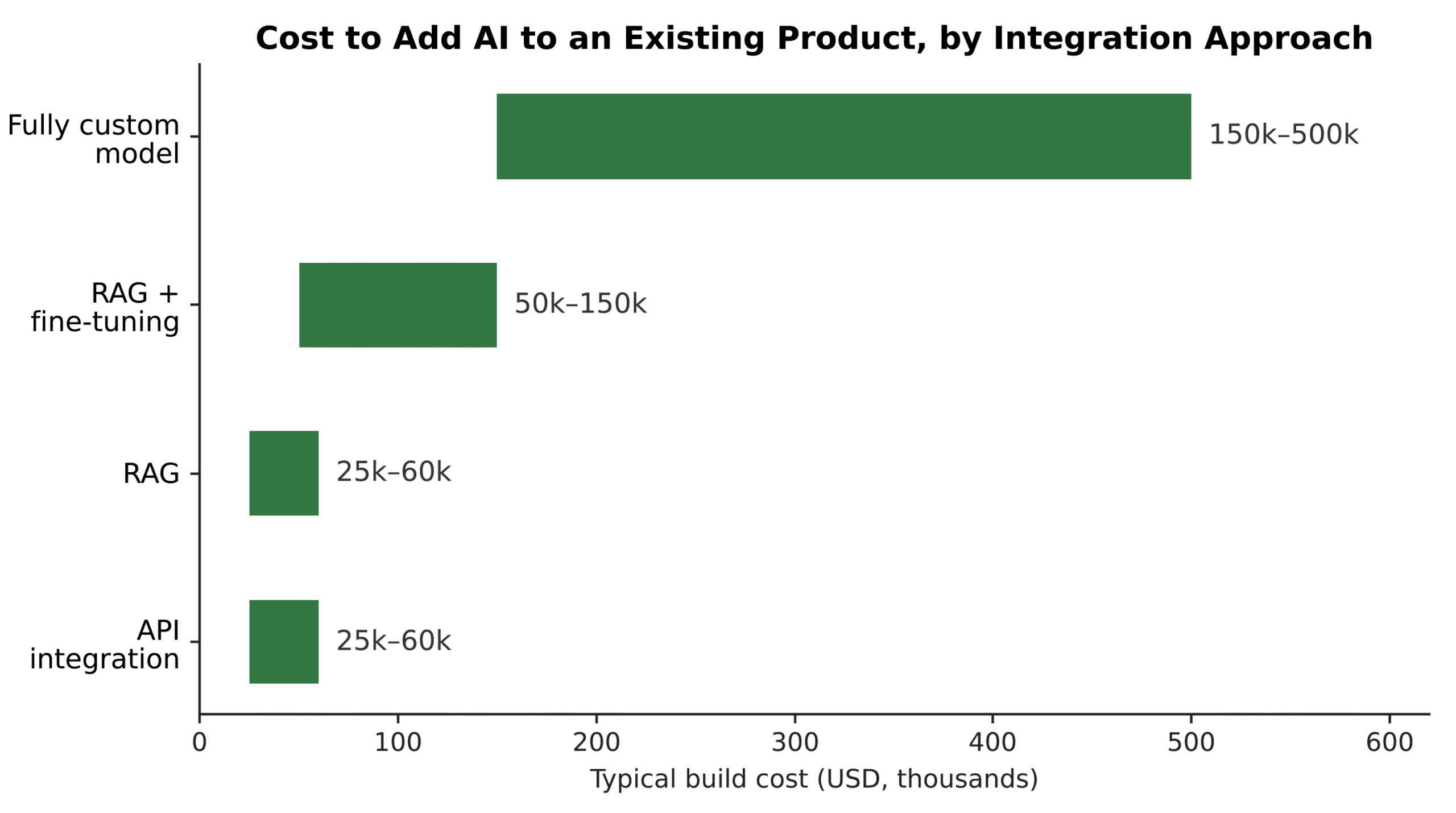
Image 1. Typical build cost ranges by integration approach, based on 2026 market data.
Cost by Integration Approach
The AI integration cost depends heavily on how much of the solution relies on existing models and how much requires custom engineering. The table below compares typical build costs, delivery timelines, and the use cases each approach supports best. These ranges help product teams compare options before choosing a more complex and expensive path.
| Approach | Typical Build Cost | Timeline | Best For |
|---|---|---|---|
| API integration | $25,000–$60,000 | 6–12 weeks | Chatbots, drafting, classification, simple automation |
| RAG (retrieval-augmented generation) | $25,000–$60,000 | 6–12 weeks | Search over your own documents/data, support assistants |
| RAG + fine-tuning | $50,000–$150,000 | 3–5 months | When RAG alone doesn’t hit accuracy targets on domain-specific language |
| Fully custom model | $150,000–$500,000+ | 6+ months | Proprietary predictions, no acceptable off-the-shelf model, strict data-residency needs |
A useful rule of thumb from teams that have shipped both is that a RAG-based feature typically runs at about 60% of the first-year cost of an equivalent fine-tuned model. Most teams should default to API and RAG first. Fine-tuning or a custom model should follow only after RAG has been measured against real business metrics and shown to fall short.

Benefits and Hidden Costs of Adding AI to Your Product
Benefits
Faster time to value: API-based features can ship in weeks rather than quarters, allowing you to validate demand before committing to a larger build.
Lower upfront risk: Starting with a proof of concept shows whether the feature works before you spend on fine-tuning or custom models.
Reuse of existing infrastructure: Because the product is already live, you are not paying for authentication, UI, or data pipelines from scratch. The investment focuses on the AI layer.
Scalable investment: You can start with a $25,000 feature and invest further only when usage data supports the decision.
Vetted expertise on demand: TechBar’s engineers hold Google Cloud, AWS, and Azure ML certifications. You can review who we are and how the team is vetted.
Budget for data cleanup before budgeting for the model. Teams that skip this step routinely exceed estimates once users report inaccurate AI outputs. The underlying data often requires correction rather than the model.
Treat the monthly API bill as a variable cost tied to adoption rather than a fixed line item. A successful launch can result in a five-figure invoice if usage is not monitored against pricing tiers.
Annual maintenance for an AI feature typically runs at 15% to 25% of the original build cost every year. Include it as a permanent operating expense in the AI integration cost estimate.
Hidden Costs
API usage costs: These scale with adoption. The better the feature performs, the more it costs to run.
Model drift and retraining: Data and user behavior change over time, so periodic retraining is required to keep accuracy stable.
Ongoing compliance monitoring: For regulated data, compliance is an ongoing budget item rather than a one-time audit.
Integration complexity: Connecting AI outputs to existing workflows, permissions, and UI can take longer than the model work itself.
Combined, hidden and ongoing costs typically add 30% to 50% beyond the initial build estimate in the first year alone.
Checklist Before You Commit to a Number
- Audit your existing data for completeness, consistency, and accessibility.
- Define the narrowest version of the feature that would prove the use case.
- Get quotes for API or RAG and fine-tuned approaches before choosing one.
- Model the monthly API cost at ten times your expected initial usage, not only launch-day usage.
- Confirm which compliance requirements apply to the data involved.
- Decide who builds it, in-house or through nearshore staff augmentation, based on the overlap and iteration speed required. TechBar’s talent pool can place a vetted AI engineer in your stack within one to two weeks.
- Set a maintenance budget equal to 15% to 25% of the build cost annually before approving the initial AI integration cost.
“The biggest budget mistakes we see aren’t in the model choice. They’re in teams pricing the build and forgetting the bill that shows up every month after.”
– Dmytro Halkin, COO, TechBar
Key Takeaways
The gap between a $25,000 AI feature and a $200,000 one usually comes from the state of your data, the suitability of an off-the-shelf API, and the team responsible for the build. Teams that scope the data work and choose the narrowest viable approach first consistently land closer to the lower end of these ranges.
Before committing to a build number, get a clear view of your data readiness and the simplest approach that can work. TechBar’s Data & AI team scopes this type of decision and can staff the build with senior nearshore engineers within one to two weeks. Talk to our team about your integration before you commit to a number.

Dmytro Halkin COO
FAQs
-
How can a company estimate AI integration cost before technical discovery?
Start with the intended use case, available data, expected request volume, integration points, and regulatory requirements. A preliminary range is possible at this stage, but a reliable estimate requires a review of data quality, the existing architecture, and the level of model customization. The estimate should separate initial development from monthly infrastructure, API, monitoring, and maintenance costs.
-
Is it cheaper to use an AI API or build a custom model?
An existing AI API is usually the less expensive and faster starting point. API integration or RAG can cover many chatbot, search, classification, and automation use cases without the cost of training a model. A custom model becomes reasonable when existing models cannot meet accuracy, data-residency, performance, or proprietary prediction requirements.
-
Which ongoing costs should be included in an AI integration budget?
The budget should include API usage, cloud infrastructure, vector database costs, monitoring, security reviews, compliance work, model evaluation, retraining, and engineering maintenance. Annual maintenance alone typically equals 15% to 25% of the original build cost, while hidden and ongoing expenses can add 30% to 50% beyond the initial estimate in the first year.
-
Can better data reduce AI integration cost?
Yes. Clean, consistent, and accessible data reduces the time required for preparation, testing, and correction after launch. Poor data can consume 30% to 60% of the total project budget and create accuracy problems that are incorrectly attributed to the model. An early data audit helps reveal this work before the final scope is approved.