

Article Highlights
- Scaling adds resources, while optimization helps the product use existing resources more efficiently. Many performance complaints require optimization before additional capacity.
- If a slow query, an ineffective cache policy, or an oversized payload is the real bottleneck, scaling infrastructure can increase the bill without resolving the cause.
- Vertical scaling suits predictable workloads, while horizontal scaling supports fluctuating or growing demand. Each option has a different cost and level of technical complexity.
- Premature scaling can introduce downtime risk, architectural complexity, and cost overruns while the original performance issue remains.
- The strongest scaling vs optimization decisions are based on real usage data. Companies such as Airbnb and Netflix optimized key bottlenecks before expanding only the capacity their systems required.
When a product slows down under load, the instinct is often to add more servers. Sometimes that is the right decision. In other cases, it simply makes an inefficient query more expensive to run. Performance describes how quickly one request completes. Scalability shows whether that speed holds as demand grows. Confusing the two can lead to unnecessary infrastructure costs or leave the product unprepared for real growth.
This guide explains the scaling vs optimization decision, the signals that point to each problem, and the checks teams should complete before committing engineering time or infrastructure budget.
What Determines Which You Need
1. Where the Bottleneck Actually Is
A single slow request under normal load is usually a performance problem. Common causes include a missing index, an N+1 query, or an unoptimized payload. A system that responds quickly for one user but degrades as concurrent load rises has a scalability problem.
Profiling before provisioning shows which issue the team is dealing with. Skipping this step can lead to scaling code that only required a database index or another focused fix.
2. Cost Trajectory
Optimization is often a focused engineering investment with a lasting payoff. Scaling infrastructure before fixing inefficient code reproduces that inefficiency across every additional server. As usage grows, the cost curve becomes steeper instead of more efficient.
3. Growth Pattern
Vertical scaling adds CPU, RAM, or storage to one machine and suits predictable, steady workloads. Horizontal scaling distributes load across multiple machines and is better suited to fluctuating or rapidly growing demand.
Horizontal scaling also adds technical complexity. Load balancing, data consistency, and failure handling become practical engineering concerns as soon as the system operates across multiple nodes.
4. Architectural Debt
If releases are slowing down, debugging is becoming harder, and each new feature increases risk across the system, the constraint is likely to be architectural. Common causes include weak module boundaries, ineffective state handling, and database design limitations.
These issues require software engineering changes. Additional hardware cannot resolve structural problems in the application.
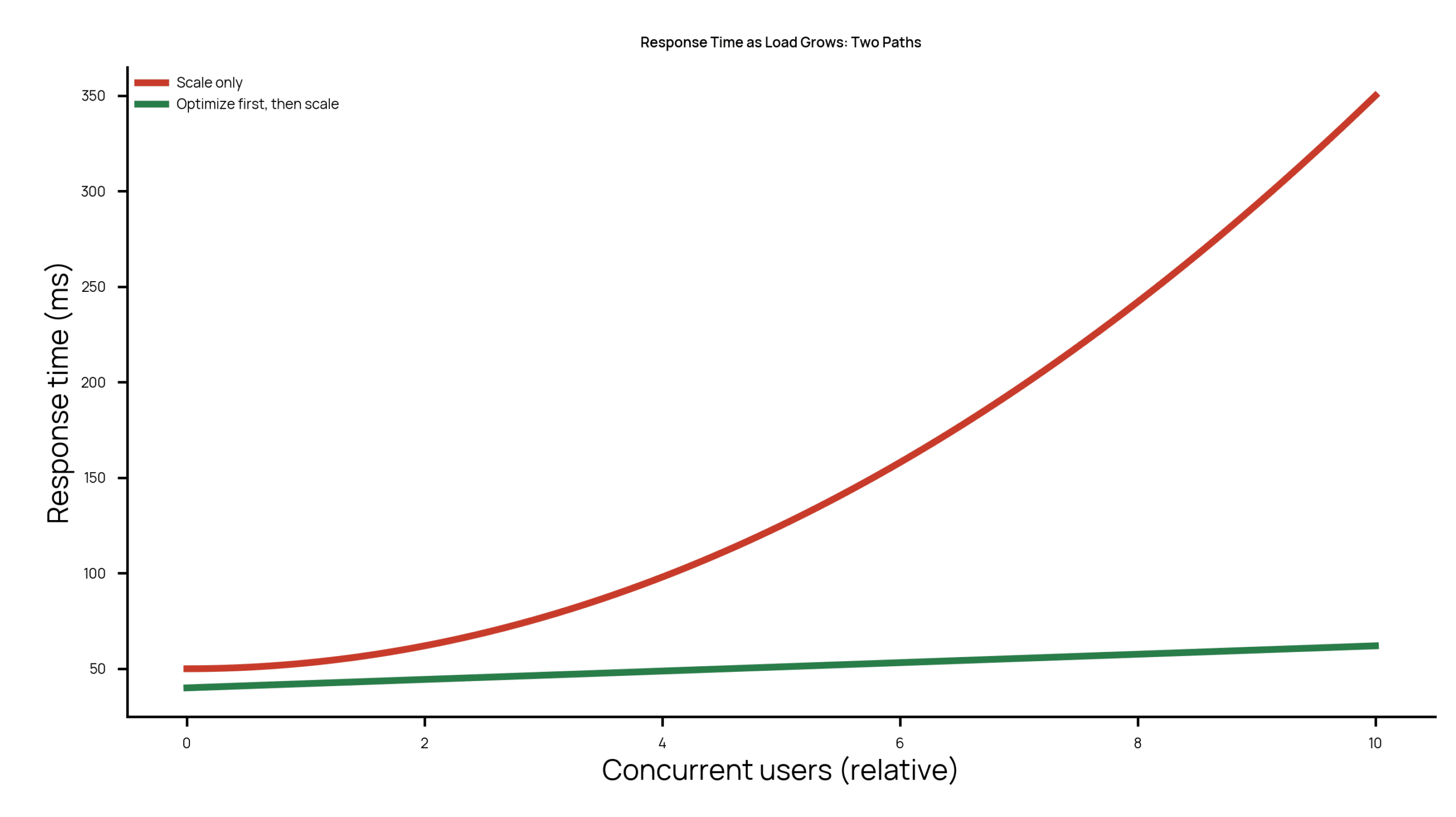
Image 1. Why fixing the bottleneck first keeps response time flat as load grows, while scaling alone just delays the same curve.
Scaling vs Optimization, Side by Side
The scaling vs optimization comparison below summarizes the problem each approach addresses, its cost profile, the signals teams should monitor, and the risk of delaying action. It can be used as a starting point for diagnosis, but the final decision should be supported by profiling and load data from the product’s real operating conditions.
| Dimension | Optimization | Scaling |
|---|---|---|
| Fixes | Inefficient code, queries, caching, payloads | Insufficient capacity for growing concurrent load |
| Cost profile | One-time engineering investment | Ongoing infrastructure spend that compounds with growth |
| Signals | Slow for a single user or request, even at low load | Fast at low load, degrades as concurrent users rise |
| Risk if skipped | Scaling masks the problem and raises the bill | Product falls over exactly when traffic matters most |
| Typical fix | Query tuning, indexing, caching, code refactor | Vertical scale-up, horizontal scale-out, load balancing |

Benefits and Common Mistakes
Benefits of Getting the Diagnosis Right
Lower total cost: Fixing the actual bottleneck once is cheaper than scaling around it indefinitely.
Better reliability under real traffic: Scaling decisions based on genuine load data are more likely to hold up during launches and traffic spikes.
Cleaner architecture over time: Teams that optimize before scaling can identify architectural debt before it becomes more expensive to correct.
Vetted judgment call: TechBar’s engineers hold AWS, Google Cloud, and Azure certifications in exactly this kind of infrastructure diagnosis, see who we are.
Profile the product under real concurrent load before making a decision. A request that is slow in isolation and a request that slows only under 10,000 concurrent users require different fixes.
Horizontal scaling before resolving a data consistency or state handling issue can make the problem more difficult because it now occurs across several nodes.
A hybrid approach is common. A quick vertical scale-up can create time to optimize the actual bottleneck, followed by horizontal scaling once the architecture can support it.
Common Mistakes
Scaling reflexively: Adding servers before profiling can increase infrastructure spending without resolving the underlying issue.
Optimizing indefinitely: Query tuning cannot replace genuine additional capacity forever. Excessive optimization can delay a scaling decision the business already needs.
Ignoring architecture friction: Slower releases and rising defect rates can also signal that the product will struggle to support growth, even when traffic is not the immediate cause.
Treating it as a one-time decision: Growth changes the diagnosis. The correct balance of scaling and optimization should be reassessed as usage patterns, architecture, and product requirements change.
Checklist Before You Spend on Either
- Profile the system under real concurrent load instead of relying only on synthetic single-request tests.
- Separate issues that are slow for one user from issues that appear as concurrent load grows.
- Check CPU, memory, storage, and network trends before deciding whether code or capacity is the primary constraint.
- Compare the projected cost of scaling the current system with the engineering cost and expected effect of optimizing first.
- Determine whether growth is predictable and suited to vertical scaling or fluctuating and better served by horizontal scaling.
- Record architectural friction, such as slow releases and fragile deployments, separately from raw traffic signals.
- Bring in outside capacity if the diagnosis itself is the bottleneck. TechBar’s staff augmentation and talent pool can place a senior cloud engineer within 1–2 weeks.
“Most teams don’t have a scaling problem. They have a query that’s been slow since launch and finally got expensive enough to notice.”
– Dmytro Halkin, COO, TechBar
Key Takeaways
The difference between a product that scales efficiently and one that becomes increasingly expensive often depends on whether the team identified the actual bottleneck before adding more infrastructure. Optimize components that use resources inefficiently and scale the parts that have reached genuine capacity. The scaling vs optimization diagnosis should be revisited as the product grows.
TechBar’s Cloud Engineering and Software Product Engineering teams profile application and infrastructure behavior before recommending a path. The team can also provide senior nearshore engineers to implement the required changes within one to two weeks. Contact TechBar to discuss what your product needs.

Dmytro Halkin COO
FAQs
-
How can you tell whether a product needs scaling or optimization?
Profile the product at low and high concurrent load. If individual requests are slow even under normal demand, optimization is usually the first step. If response times remain stable at low load but degrade as concurrency rises, the system is likely approaching a capacity limit. Infrastructure metrics, query traces, application profiling, and load tests should be reviewed together.
-
Should a team optimize before scaling?
In most cases, the team should correct clear inefficiencies before adding capacity. This prevents inefficient code, database queries, or caching behavior from being reproduced across a larger infrastructure footprint. If the product faces an immediate traffic risk, temporary vertical scaling can create time for targeted optimization.
-
When should a product use vertical scaling instead of horizontal scaling?
Vertical scaling is suitable when demand is predictable, the application cannot yet operate across several nodes, or a short-term capacity increase is required. Horizontal scaling is more appropriate for fluctuating demand, continued growth, and systems designed for distributed operation. The choice also depends on cost limits, availability requirements, and data consistency needs.
-
How often should the scaling vs optimization decision be reviewed?
Review it after major growth changes, new feature releases, infrastructure migrations, repeated performance incidents, or a sustained increase in cloud costs. A decision that was correct at one stage of the product can become inefficient as traffic patterns, architecture, and business requirements change.