Article Highlights
- SaaS product scaling starts by defining expected growth, critical user journeys, service-level objectives, and acceptable unit costs.
- Tenant-aware monitoring reveals performance and consumption patterns hidden by platform-wide averages.
- Query optimization, caching, queues, horizontal scaling, and overload controls should be tested before major architectural changes.
- Sharding is appropriate after indexing, read separation, archiving, and table partitioning reach their limits.
- Component extraction is justified when independent capacity, deployment, data, or failure boundaries provide measurable value.
- Scaling results should be validated through reliability metrics, gradual rollout, rollback testing, and unit economics.
SaaS scaling should begin with the first constraint that prevents the product from meeting its expected load, reliability, or delivery targets. The limiting factor can be a slow database query, synchronous background work, shared tenant resources, an external dependency, or a release process that cannot support frequent changes.
A full rewrite is a late-stage option. It is justified when targeted improvements cannot provide the required capacity, reliability, security, or development speed at an acceptable cost and risk. In most cases, SaaS product scaling should follow a staged sequence:
Define → Measure → Optimize → Scale and Protect → Partition → Extract Selectively
This order keeps architectural changes proportional to the confirmed problem. The team defines the target, measures the first constraint, improves the existing implementation, protects shared capacity, and introduces data or service separation only when shared components create a measurable limit.
Define What Scaling Means for Your SaaS Product
Before changing the architecture, define the type and amount of growth the product must support. SaaS product scaling can involve more tenants, more users within each tenant, higher transaction frequency, larger data volumes, heavier background processing, new regions, larger customers, or stricter availability requirements.
These growth patterns create different technical pressures. More tenants can increase isolation and provisioning requirements, while a small number of large customers can create uneven database, reporting, and integration loads. Regional expansion introduces latency, data residency, deployment, and support considerations. The scaling target must therefore describe the expected business demand rather than a general requirement to “handle more traffic”.
Microsoft’s guidance for SaaS workloads recommends modelling average, best-case, and worst-case growth scenarios. It also advises teams to identify scale points, such as the number of tenants, users, or transactions at which the current architecture requires a change.
The following baseline connects business growth to measurable system requirements:
| Area | Current baseline | Target |
|---|---|---|
| Active tenants | Current number and growth rate | Expected number in 12–24 months |
| Concurrent users | Current peak by tenant and product area | Planned peak |
| Requests or transactions | Current rate per second or minute | Required throughput |
| Data volume | Current size and monthly growth | Projected size and retention period |
| Response time | Current p95 and p99 latency | Required service-level objective |
| Availability | Current measured result | Target availability |
| Background processing | Current queue delay and completion time | Required completion window |
| Cost | Current cost per tenant or transaction | Acceptable unit cost at target scale |
Average load is insufficient for SaaS product scaling decisions because it hides the periods and customers that create the greatest pressure. The model should include peak traffic, the largest tenants, end-of-month processing, reporting periods, bulk imports and exports, simultaneous scheduled jobs, product launches, and temporary failures of dependent services.
Growth scenarios should also account for combined pressure. A reporting period can coincide with a bulk import, a traffic increase, and slower responses from a third-party service. Testing each factor separately can miss the resource contention and queue growth that occur when several conditions overlap.
The output of this stage is a scaling brief containing the expected growth profile, current baseline, target capacity, performance and availability requirements, acceptable unit cost, and known scale points. This gives the team a measurable basis for the next SaaS product scaling decisions.
Find the First Bottleneck Before Changing the Architecture
A slow application does not automatically need more servers. The constraint can be an inefficient database query, shared lock, exhausted connection pool, synchronous integration, growing queue, or one tenant consuming a disproportionate share of common resources.
The first technical step is to locate the component that limits the complete user flow. Adding capacity elsewhere can increase cost without changing response time or throughput.
Measure the Complete Request Path
Start with latency, throughput, concurrency, error rates, and timeouts for critical user journeys. Connect these results to the central processing unit, memory, disk, and network usage across the services involved in each request.
Database analysis should include query duration, lock contention, connection-pool usage, storage input/output, and replication delay where applicable. Cache hit rate, queue depth, processing lag, third-party application programming interface latency, and rate-limit errors can reveal constraints outside the main application service.
Cost data should be reviewed alongside performance. A component can continue meeting its response target while requiring increasingly expensive capacity. Track cloud cost by service, tenant group, and subscription tier to identify scaling decisions that protect performance but weaken unit economics.
Add Tenant Context
Global infrastructure metrics can hide problems in a multi-tenant product. Record activity, health, latency, errors, resource consumption, and cost with tenant and subscription-tier context.
AWS SaaS Lens guidance recommends tenant-aware operational views that show the activity and consumption patterns of individual tenants and tiers. This helps teams identify a customer group or service that is saturating shared capacity before the effect becomes visible in platform-wide averages.
Tenant-level data also helps distinguish general capacity limits from noisy-neighbor behavior. If one tenant creates most of the database load, queue growth, or external requests, the appropriate SaaS product scaling response can involve throttling, workload isolation, scheduling, or a different service tier rather than scaling the complete platform.
Test Real Operating Conditions
Load tests should reproduce the distribution of real traffic rather than sending identical requests at a constant rate. Use production-like data volumes and include small tenants, large tenants, and concurrent activity across several tenant tiers.
The test should cover warm and cold caches, background jobs, scheduled processing, downstream service limits, retries, timeouts, and partial failures. Run the expected peak load with an additional safety margin, then observe where latency, queue delay, errors, or resource saturation begin to increase.
A useful test result identifies the scale point at which a specific component stops meeting its target. It should record the triggering load, affected user flow, limiting resource, recovery behavior, and cost of the additional capacity required. This evidence determines the next action.
High resource usage indicates pressure, but it does not confirm the root cause by itself. Validate the bottleneck through a controlled test or targeted change, then compare latency, throughput, errors, and cost before making an architectural decision.
Apply the Lowest-Risk Changes First
Many SaaS products can support substantial growth after targeted optimization. Replacing the architecture before testing smaller changes increases delivery risk, expands the regression surface, and can leave the original bottleneck unresolved.
The next stage of SaaS product scaling should focus on changes that improve capacity or reliability without altering major system boundaries.
Optimize the Application Layer
Start with code paths used by critical journeys and high-volume operations. Look for repeated calculations, per-record database queries, oversized application programming interface responses, missing pagination, inefficient serialization, and repeated retrieval of data that rarely changes.
File processing and external service calls should also be examined. A user request can remain open while the application processes a document or waits for a third-party response. This consumes application capacity and allows a slow dependency to affect the complete workflow.
Common improvements include a content delivery network for static files, caching for frequently requested data, connection pooling, response pagination, payload limits, and explicit timeouts. Circuit breakers can stop repeated calls to an unavailable dependency, while stateless application instances can support horizontal scaling behind a load balancer.
Caching should be introduced only after the access pattern is understood. Tenant-specific, sensitive, or frequently updated data requires clear cache keys, isolation, expiration, and invalidation rules. An incorrect cache design can return stale information or expose data across tenant boundaries.
Release one targeted optimization at a time and compare the same latency, throughput, error, and cost metrics used in the baseline. This makes it possible to confirm which change removed the constraint and which changes produced little measurable value.
Move Suitable Work to Background Processing
Tasks that do not need to finish inside the user request can be moved to a queue. Typical candidates include report generation, document processing, notifications, media processing, data imports, integration synchronization, and scheduled calculations.
Each job should have a unique identifier, timeout, retry limit, and retry policy with backoff. Processing should be idempotent so that a repeated message does not create duplicate records, notifications, or transactions. Jobs that continue to fail should move to a dead-letter queue for investigation instead of retrying indefinitely. When a job is triggered by a database change, the system should also prevent the state update and message publication from becoming inconsistent. A transactional outbox or an equivalent delivery pattern can ensure that committed work is eventually published without relying on a fragile dual write.
Users should be able to see that processing is pending, completed, or failed. Operational monitoring should track queue depth, queue lag, processing duration, retry volume, and dead-letter growth.
Adding workers can increase processing capacity, but it also increases pressure on databases, storage, and external services. Worker autoscaling supports SaaS product scaling only when downstream components can handle the additional concurrency. Otherwise, the bottleneck moves to another part of the workflow.
Protect the System During Overload
The platform needs explicit behavior when incoming work exceeds safe processing capacity. Backpressure should delay or reject new work before queues, databases, or external dependencies become saturated.
Request prioritization can preserve capacity for critical operations, while graceful degradation can temporarily disable expensive non-critical functions. Load shedding should define which requests can be rejected, how clients are informed, and how retries are prevented from creating additional pressure.
These controls should be tested during traffic spikes, dependency slowdown, queue growth, and recovery after load returns to normal. Tenant-specific limits and isolation are addressed separately because they protect customers from disproportionate consumption by other tenants.
Scale the Data and Multi-Tenant Architecture
The database is often the first stateful constraint in SaaS product scaling. Sharding can increase capacity, but it also complicates joins, schema migrations, rebalancing, tenant movement, and transactions across shards. Apply simpler changes first and introduce data distribution only when measured limits justify it.
Recommended Scaling Sequence
| Stage | Changes to evaluate | Purpose |
|---|---|---|
| 1. Improve query efficiency | Optimize slow queries, correct indexes, and remove unnecessary reads | Reduce database work per request |
| 2. Control connections and repeated reads | Tune connection pools and cache suitable reads | Prevent connection exhaustion and reduce repeated database access |
| 3. Separate workloads | Move reporting away from transactional traffic and add read replicas where consistency requirements allow | Prevent analytical queries from affecting user operations |
| 4. Manage data growth | Archive cold data and partition large tables | Keep active datasets smaller and easier to process |
| 5. Distribute data | Shard tenants or datasets across database instances | Increase capacity after earlier options reach their limits |
This sequence is a decision path rather than a mandatory architecture. The team should stop when the current change delivers the required capacity, reliability, and unit cost.
Table partitioning and sharding solve different limits. Partitioning can improve query pruning, maintenance, and data lifecycle management inside one database system. Sharding distributes data and load across independent database instances, but introduces routing, rebalancing, migration, and cross-shard transaction concerns.
Assess the Data Model
| Assessment area | Questions to answer |
|---|---|
| Growth | Which tables grow fastest, and which tenants generate most of the data? |
| Access patterns | Which queries create the most input/output load, and do tenant groups use data differently? |
| Consistency | Which operations require strong consistency, and which reads can tolerate replication delay? |
| Partitioning | Can tenant_id, region, date, or another stable field serve as a practical partition key? |
| Operations | How will schema migrations, backups, restores, and tenant movement work across partitions? |
Reporting is a common candidate for separation. A dedicated read model, replica, or analytical store can protect transactional traffic from complex queries, but data freshness requirements must remain explicit.
Manage Noisy-Neighbor Effects
In a shared SaaS environment, one large tenant can consume enough database, queue, or worker capacity to affect other customers. AWS guidance recommends detecting tenant consumption patterns and responding through scaling, throttling, or isolation of high-demand resources.
Protection can include per-tenant rate and concurrency limits, separate queues, workload priorities, resource quotas, and isolated instances of performance-critical services. These controls should reflect subscription tiers and service-level commitments rather than applying the same limits to every tenant.
Full tenant isolation is not always required for SaaS product scaling. Shared application services can remain in place while a database, worker pool, queue, or high-demand service receives dedicated capacity. This targeted approach limits architectural change and preserves the cost benefits of shared infrastructure.
Extract Only the Components That Need Independent Scaling
A modular monolith can continue supporting a growing SaaS product when its modules remain testable, deployable, and operationally manageable. Component extraction is justified when a specific capability needs an independent capacity, deployment, data, or failure boundary.
Good Candidates for Extraction
| Component | Reason for independent operation |
|---|---|
| Report generation | Long-running, processor- and memory-intensive work |
| File processing | Independent background capacity requirements |
| Search | Different data model and query pattern |
| Notifications | High-volume asynchronous workload |
| Media processing | Specialized compute requirements |
| Audit logging | High write volume and retention requirements |
| Public integrations | Separate rate limits and external failure patterns |
| Billing or metering | Clear domain boundary and specific reliability requirements |
Extraction should solve a measured constraint. A component should usually remain inside the application when it has a similar load profile, depends heavily on shared transactions, is always released with other modules, or gains little value from independent scaling.
The operating model also matters. A separate service introduces network failures, interface versioning, distributed tracing, additional deployments, data consistency concerns, and more complex incident response. If the team cannot operate these responsibilities reliably, extraction can make SaaS product scaling harder rather than improve it.
Extract Incrementally
For an active product, the strangler pattern allows a component to move without replacing the complete application:

Keep the consumer-facing contract stable where possible, or introduce a compatibility layer while traffic moves gradually. Compare correctness, latency, failure behavior, and cost before expanding the rollout, and keep rollback available until the new component is proven under production load.
When Partial Rebuilding Is Justified
Selective replacement should be considered when unsupported technology blocks security changes, the component cannot be tested or deployed safely, or its data model prevents tenant isolation. Other valid triggers include shared state that blocks horizontal scaling, repeated remediation with poor results, and availability requirements that the existing boundary cannot meet.
These conditions do not require rebuilding the complete system. Component-level decisions keep SaaS product scaling focused on the parts that create the confirmed constraint while preserving stable business logic elsewhere.
Validate Scaling Through Reliability and Unit Economics
A scaling change should be considered successful only after it is validated under production conditions. The product must meet its reliability targets without creating an unsustainable cost per customer or transaction.
Define Reliability Criteria
| Area | Metric to validate |
|---|---|
| User journeys | Availability and successful request rate |
| Performance | p95 or p99 latency |
| Background processing | Maximum queue delay and job completion time |
| Data | Freshness and processing accuracy |
| Recovery | Recovery time and acceptable degraded behavior |
A service-level objective (SLO) defines the target level of reliability for a critical user journey over a specified period. It helps the team prioritize SaaS product scaling work when reliability, performance, and feature delivery compete for engineering capacity.
Release Changes Gradually
Each scaling change should follow the same validation path:
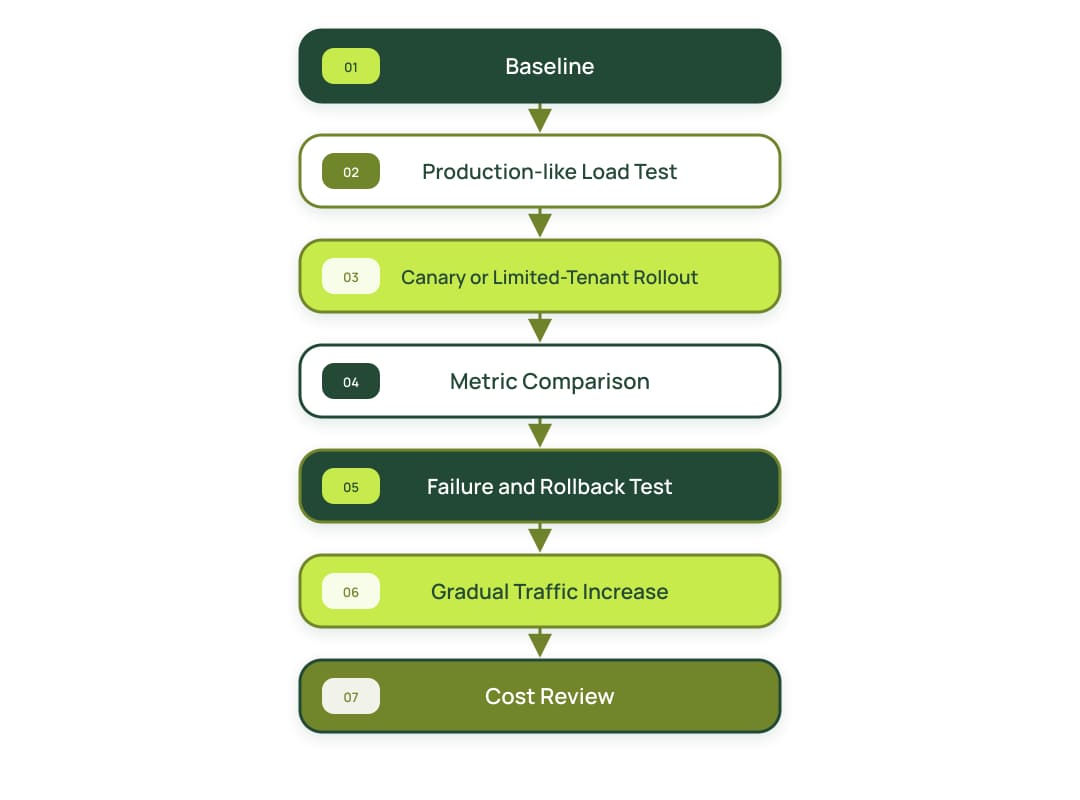
This process confirms performance gains, exposes regressions, and verifies that rollback works before the change reaches all tenants.
Track Unit Economics
The total cloud bill can increase as product usage grows. The stronger signal is cost per active tenant, user, transaction, generated report, or gigabyte stored. Infrastructure cost as a percentage of revenue also shows if spending remains aligned with business growth.
Microsoft’s SaaS cost guidance recommends connecting architecture decisions to cost of goods sold (COGS) and modelling the marginal cost of each customer. It also highlights the risk of high resource consumption that does not produce a corresponding increase in customer revenue.
A successful SaaS product scaling change should improve capacity or reliability while keeping the selected unit cost within its target range.
Compact SaaS Scaling Roadmap
The roadmap below turns SaaS product scaling into a staged process. Progress to a more invasive phase only when evidence shows that the current approach cannot meet the approved target.
| Phase | Main actions | Exit criteria |
|---|---|---|
| 1. Define | Set growth scenarios, critical journeys, service-level objectives, and unit-cost targets | Target scale and acceptance criteria approved |
| 2. Measure | Add tracing, database metrics, tenant-aware monitoring, and realistic load tests | First bottleneck identified with evidence |
| 3. Optimize | Improve queries, caching, payloads, connection pools, and synchronous processing | Low-risk improvements validated and remaining constraint documented |
| 4. Scale and Protect | Add horizontal scaling, queues, throttling, backpressure, and tenant limits | Predictable behavior confirmed during peaks and overload |
| 5. Partition | Separate reads, partition data, and isolate selected tenant workloads | Stateful components support projected growth |
| 6. Extract Selectively | Move components with distinct capacity, deployment, or reliability requirements | Independent operation delivers measurable value |
This sequence keeps SaaS product scaling tied to confirmed constraints and measurable exit criteria instead of a predetermined architecture.
Common SaaS Scaling Mistakes
The following mistakes can increase cost and operational complexity without resolving the constraint that limits SaaS product scaling.
Rewriting Before Measuring
A rewrite can reproduce the same data, traffic, and dependency problems in a new codebase if the original bottleneck was never identified. Measure the current system first and confirm which constraint requires structural change.
Moving to Microservices Too Early
More services introduce network failures, additional deployments, interface versioning, distributed monitoring, and data consistency concerns. A component should be extracted only when independent scaling, failure isolation, or release ownership provides measurable value.
Autoscaling Only the Application Layer
Additional application instances increase pressure on databases, queues, external application programming interfaces, and connection pools. SaaS product scaling must account for the capacity of the complete request path.
Testing with Small or Uniform Data
Query behavior changes as tables, indexes, and tenant histories grow. Load tests should use production-like data volumes, access patterns, tenant sizes, and traffic distribution.
Ignoring Tenant-Level Metrics
Global averages can appear healthy while one large tenant affects a complete subscription tier or shared service. Track latency, errors, resource consumption, and cost by tenant or tier.
Sharding Before Query Optimization
Sharding introduces lasting complexity into queries, schema migrations, transactions, rebalancing, and tenant movement. It should follow query tuning, indexing, caching, read separation, and cold-data archiving.
Scaling Infrastructure Without Tracking COGS
A technically scalable product can become commercially unsustainable if the cost of serving each new tenant grows faster than expected. Track cost of goods sold (COGS) and unit economics alongside reliability and performance throughout SaaS product scaling.
Key Takeaways
SaaS product scaling should begin with a measurable constraint. Define the expected growth, reproduce it through realistic testing, and identify the first component that prevents the product from meeting its capacity, reliability, or cost targets. A practical sequence is: define, measure, optimize, scale and protect, partition, and extract selectively.
Many products can support significant growth through query optimization, caching, background processing, horizontal scaling, tenant limits, and selective data partitioning. Microservices, sharding, and partial rebuilding become relevant when simpler changes have reached a confirmed limit.
If growth is exposing limits across your architecture, data, or delivery process, explore Techbar’s Software Product Engineering services. We help product teams identify the constraint, select a proportionate solution, and validate it under real operating conditions.

Dmytro Halkin COO
FAQs
-
How can a SaaS product scale without a complete rewrite?
Start by measuring critical user journeys and identifying the first confirmed bottleneck. Query optimization, caching, queues, horizontal scaling, tenant limits, and data lifecycle changes can often provide substantial capacity before structural replacement is required.
-
Can a monolithic SaaS application support significant growth?
Yes. A modular monolith can support SaaS product scaling when its modules remain testable, deployable, and operationally manageable. Extraction becomes useful when a specific component needs independent capacity, release ownership, or failure isolation.
-
What metrics should be tracked before scaling a SaaS product?
Track p95 and p99 latency, throughput, concurrency, error rates, queue delay, database performance, cache efficiency, and third-party dependency latency. Add resource consumption and cost by tenant or subscription tier to detect noisy-neighbor effects and changes in unit economics.
-
When should a SaaS product move to microservices?
Move a component when independent scaling, deployment, data ownership, or failure isolation creates measurable value. Similar load patterns, shared transactions, and coordinated releases usually support keeping the component inside the existing application.
-
When does a SaaS database need sharding?
Sharding should be considered after query tuning, indexing, connection pooling, caching, read separation, archiving, and table partitioning reach their measured limits. The decision must also account for schema migrations, tenant movement, cross-shard transactions, and operational recovery.
-
How can a SaaS platform prevent one tenant from affecting others?
Use tenant-aware monitoring to identify consumption patterns, then apply rate limits, concurrency limits, resource quotas, separate queues, or targeted isolation. Dedicated infrastructure can be limited to the database, worker pool, or service that creates the constraint.
-
How do you confirm that a scaling change worked?
Compare production results with the original baseline and service-level objective. A successful SaaS product scaling change should improve capacity, latency, reliability, or recovery while keeping cost per tenant, user, transaction, or other business unit within its target.