
Article Highlights
- An AI feasibility assessment evaluates a defined use case across business value, data readiness, product quality, architecture, cost, and risk.
- A use case needs a measurable outcome, current-process baseline, accountable owner, and comparison with a simpler non-AI approach.
- Data volume is insufficient on its own. Production access, usage rights, quality, coverage, freshness, lineage, and validated ground truth can determine feasibility.
- AI quality should be measured through task-specific evaluations, an error taxonomy, segment-level results, and release-blocking acceptance criteria.
- Architecture testing must cover integrations, permissions, latency, failure handling, observability, versioning, and rollback across the complete system.
- A decision-oriented pilot should test cost per accepted outcome and residual risk under realistic conditions before a production commitment.
An AI feasibility assessment evaluates a specific use case rather than the organization’s general AI readiness. It should determine whether the proposed workflow can improve a measurable business outcome, use suitable data legally, meet defined quality and performance targets, operate within the existing architecture, and remain economically and operationally controlled in production.
Treat these requirements as independent decision gates. A strong result in one area must not offset a critical blocker in another. High model quality cannot compensate for missing data rights, and a good user experience cannot justify an agent that can execute financial actions without effective authorization, auditability, and rollback.
Define the Use Case Before Evaluating the Technology
Start with a specific workflow rather than a model, vendor, or platform. The use case should identify the user, the decision or action supported by AI, the available inputs, the expected output, and what happens after the output is produced.
Document how the process works today, including its cost, duration, error rate, and manual effort. Define the boundary of the AI component as clearly as its task. For example, a system can prepare a refund recommendation while the final approval remains with an authorized employee.
Google’s Machine Learning Problem Framing guidance recommends defining the product goal in non-machine-learning terms, checking if a predictive model, generative AI, or a simpler approach is appropriate, and using a non-AI solution or heuristic as a baseline. The product must also be able to take a useful action based on the model output.
Separate the Business Outcome from the AI Metric
A model metric measures system behavior. A business metric shows if that behavior improves the workflow. Both are required in an AI feasibility assessment. For example, the following metrics are possible:
| Business outcome | AI or system metric |
|---|---|
| Reduce document review time | Field extraction accuracy |
| Reduce unresolved support requests | Resolution and escalation rate |
| Increase completed applications | Classification recall and response latency |
| Reduce manual fraud reviews | Precision at the selected recall level |
| Improve knowledge search | Retrieval recall and grounded-answer rate |
Improving the AI metric does not guarantee a better business result. Higher extraction accuracy, for example, creates limited value if employees still spend the same amount of time reviewing every field. Google recommends defining business success metrics separately from model evaluation metrics such as accuracy, precision, and recall.
Section Output
The use-case brief should record the workflow, current baseline, target business outcome, product owner, AI boundary, acceptable error conditions, and strongest non-AI alternative. It should also document the assumptions that later evaluation and pilot stages must confirm.
Redesign or stop the use case if the expected outcome cannot be measured, the AI component has no clear responsibility boundary, or an existing rules-based solution can achieve the required result with lower cost and risk.
Data Feasibility: Availability Is Only the First Check
Having a large volume of data does not make an AI use case feasible. The team must confirm that the required data is accessible when the product needs it, represents actual production conditions, and can be legally processed for the intended purpose.
AWS guidance for a proof of concept recommends assessing data inventory, access, lineage, quality, freshness, and business coverage. It also calls for a ground-truth evaluation dataset validated through historical records, verified documentation, and subject-matter expert review.
The data portion of an AI feasibility assessment should cover four areas.
Availability and Production Access
Identify each data source, its owner, access method, update frequency, and expected availability. Data used during development must also be obtainable in production under the required latency and reliability conditions. A manually prepared export may support an experiment but does not prove that the production workflow is viable.
Usage Rights and Restrictions
Confirm that the organization can use the data for the intended activity: model training, fine-tuning, retrieval, evaluation, or inference. Classify personal, confidential, and regulated information, then document applicable retention, residency, deletion, and access requirements.
If data will be sent to an external model provider, review the provider’s processing terms, storage behavior, supported regions, and controls for preventing submitted data from being used outside the agreed purpose.
Quality and Coverage
The dataset should represent normal production inputs, edge cases, and scenarios where an incorrect output would have serious consequences. Record missing values, duplicates, incorrect labels, outdated records, source limitations, and known coverage gaps.
Freshness rules and version history are also required. Without them, the team cannot reproduce an evaluation, trace a failure to its source, or determine if declining accuracy resulted from a model change or changing data.
Ground Truth and Evaluation Separation
The team needs examples of acceptable and unacceptable outputs, supported by criteria approved by domain experts. The evaluation set should remain separate from training, fine-tuning, and prompt-development data to reduce the risk of measuring performance on examples already used to improve the system.
The set should include realistic ambiguity, incomplete inputs, unusual formats, and high-risk cases rather than only straightforward examples. If experts cannot consistently agree on the correct result, the team may need to redefine the task or use an evaluation method that allows more than one acceptable answer.
Match the Review to the AI Approach
Different AI approaches require different evidence. The following checks should be added to the common assessment of access rights, quality, lineage, and production availability.
| AI approach | Data checks |
|---|---|
| Predictive machine learning (ML) | Features, labels, class balance, representativeness, and consistency between training and production inputs |
| Generative AI | Representative prompts, expected outputs, known failure examples, ambiguous cases, and safety scenarios |
| Retrieval-augmented generation (RAG) | Source documents, access permissions, freshness, parsing, chunking, indexing, and retrieval relevance |
| Fine-tuning | Curated input-output pairs, labeling consistency, usage rights, dataset versions, and separation of training and evaluation data |
| AI agent | Tool definitions, workflow rules, permission boundaries, transaction history, failure states, and recovery scenarios |
The data review should end with a Data Feasibility Report that records sources, owners, access rights, restrictions, quality findings, coverage gaps, the approved evaluation dataset, and the plan for keeping production data current. The report should distinguish resolvable data gaps from blockers. Offline evaluation or pilot work should not proceed until the data required for the relevant stage is legally accessible, sufficiently representative, and obtainable under the expected operating conditions.
Quality and Evaluation: Define Acceptable Failure
For generative AI, accuracy is often too narrow to describe product quality. The system can return a correct answer while failing to follow instructions, use approved sources, or respond safely. An AI feasibility assessment therefore needs evaluations that test the expected behavior of the complete product.
OpenAI recommends task-specific evaluations based on representative test data, supported by both automated scoring and human judgment. Evaluations should run again after changes to the model, prompts, tools, retrieval setup, or application logic.
Create an Error Taxonomy
Before defining acceptance criteria, identify the failure types relevant to the use case. For each error, document its expected frequency, business impact, detection method, acceptable rate, and required response.
Errors should be assessed separately because their consequences differ. An incomplete answer can require correction, while disclosure of restricted data or an unauthorized transaction should block the workflow and trigger escalation. A high average score must not hide rare but serious failures.
Select Metrics for the Use Case
Metrics should reflect the task, the expected output, and the consequences of an incorrect result. The AI feasibility assessment should measure performance for critical user and data segments, not only across the complete evaluation dataset.
Results can differ by language, document type, customer group, input quality, or risk category. These differences should remain visible in the evaluation results so that strong performance in common scenarios does not conceal failures in an important segment.
Define Acceptance Criteria
Replace an abstract target such as “95% accuracy” with minimum results for each critical metric. Define scenarios where errors are unacceptable, conditions requiring human review, refusal and escalation rules, the maximum permitted rate of unsafe outputs, and performance requirements for critical segments.
The criteria should also specify the permitted degradation after a model or system update. Each release-blocking metric must pass independently instead of being absorbed into an average result.
Evaluate the Complete System
Google’s deployment testing guidance covers input data, feature logic, new model versions, serving infrastructure, and interactions between pipeline components. These checks confirm that the full system operates correctly before release, not only that the model performs well in an isolated test.
For generative AI products, system testing should also cover prompts, retrieval, permissions, external tools, output validation, refusal behavior, and escalation paths. A model can pass an offline evaluation while the product fails because it receives outdated context or cannot handle an unavailable dependency.
Section Output
The AI feasibility assessment should retain a versioned evaluation dataset, baseline results, results by error category and critical segment, a human-review protocol, regression tests, and documented limitations. Each evaluation run should identify the model and system configuration tested.
The completed evaluation defines the quality threshold for release, the failures that block deployment, and the cases that require human review.
Architecture, Stack, and Integration Feasibility
Model quality alone does not determine feasibility. The complete system must meet requirements for latency, availability, security, integration, observability, and recovery. This part of the AI feasibility assessment establishes if the proposed approach can operate within the company’s current technical environment.
Choose the Simplest Sufficient Approach
The architecture should match the problem without adding unnecessary model or workflow complexity.
| Requirement | Possible starting approach |
|---|---|
| Fixed, explainable rules | Rules engine or standard automation |
| Prediction from structured historical data | Predictive machine learning |
| Summarization or generation from supplied context | Model application programming interface (API) with prompts and context |
| Answers from private or frequently updated documents | Retrieval-augmented generation (RAG) |
| Stable specialized output format or behavior | Fine-tuning when prompting and retrieval do not meet the required format, behavior, or task performance |
| Multi-step work across external systems | AI agent with restricted tools and approvals |
AWS recommends starting with prompting for tasks that rely on the model’s existing capabilities, adding RAG when answers require proprietary or current information, and considering fine-tuning for a specific format, terminology, or narrow task. Agent-based architecture is more appropriate for multi-step workflows that require controlled access to external tools.
Architecture Checklist
The AI feasibility assessment should document the choice between a managed API, a self-hosted model, and a hybrid setup. Confirm regional availability, quotas, rate limits, provider service-level agreements, expected peak concurrency, and the target for 95th-percentile latency.
Models, prompts, data, and configuration should be versioned. Components need to support independent testing, while model or provider failures require a defined fallback. Observability should cover model calls, retrieval, tool execution, latency, cost, and errors. Sensitive data should appear in logs and traces only when explicitly required and protected.
The release process also needs a rollback path for model, prompt, retrieval, and configuration updates. Without version history and rollback, the team cannot isolate a regression or restore the previous behavior safely.

Integration Checklist
Identify the systems of record and confirm the available APIs, authentication methods, data contracts, and permission boundaries. Test timeout handling, rate limits, unavailable dependencies, and partial failures under realistic conditions.
Repeated requests must not create duplicate transactions. Writes to external systems need confirmation, rollback, or reconciliation procedures. The workflow should also define human handoff and the response to conflicting or missing records.
Dependence on one model provider should be an explicit architecture decision. If the business impact of provider failure is unacceptable, the design needs a tested fallback or a controlled degraded mode.
If the existing systems, integrations, and technical constraints have not yet been documented, Techbar’s technical discovery checklist outlines the architecture, integration, scope, and risk questions to resolve before implementation estimates are approved.
The architecture stage of the AI feasibility assessment should produce a Target Architecture Diagram and Integration Risk Register showing data flows, trust boundaries, model dependencies, systems of record, failure paths, and assigned risk owners.
Cost Feasibility
Token prices and graphics processing unit (GPU) costs show only one part of AI product economics. An AI feasibility assessment must include the full cost of producing an output that meets the defined acceptance criteria.
The calculation should cover data preparation and labeling, inference or model hosting, embeddings, retrieval, vector storage, external tools, repeated calls, evaluation infrastructure, monitoring, security controls, human review, incident support, and ongoing maintenance of models, prompts, and data.
Our guide to the cost of adding AI to an existing product provides a broader breakdown of development and operating expenses across API integration, retrieval-augmented generation, fine-tuning, and custom model approaches.
Calculate Cost per Accepted Outcome
Operating cost per accepted outcome = total recurring cost during the measurement period ÷ accepted outcomes during the same period
Recurring cost can include model usage, infrastructure, retrieval, orchestration, human review, monitoring, support, and expected reprocessing or retry costs.
Fully loaded cost per accepted outcome = (amortized implementation cost + recurring cost during the measurement period) ÷ accepted outcomes during the same period
One-time costs for integration, data preparation, security review, and initial evaluation should be amortized across a defined forecast period or expected number of accepted outcomes.
Test Different Usage Scenarios
The AI feasibility assessment should calculate low, expected, and peak-volume scenarios. Record average and 95th-percentile input and output sizes, the number of model and tool calls per workflow, and the cost of unsuccessful requests.
Human-review rates must be included because they can materially change the cost of an accepted result. The estimate should also cover increased storage, retrieval, monitoring, and support requirements as usage grows.
Set spending limits for each user, workflow, or customer account. Alerts should report unexpected increases in tokens, tool calls, retries, and human reviews, while hard budget caps should prevent uncontrolled spending.
Security, Privacy, and Business Risk
Risk depends on more than the selected model. The AI feasibility assessment must consider the data being processed, the context in which outputs are used, the system’s level of autonomy, and the consequences of an incorrect action.
A system that drafts internal text requires different controls from one that changes account details or supports decisions about employment, credit, or healthcare. The greater the autonomy and potential impact, the stronger the approval, monitoring, and recovery requirements.
Risk Tiers
| Product behavior | Example | Required control level |
|---|---|---|
| Assistive | Draft, summary, internal search | User verification and data controls |
| Advisory | Recommendation, prioritization, risk flag | Explanation, validation, and formal escalation |
| Action-taking | Payment, account update, external message | Least privilege, approval, audit records, and rollback |
| High-impact decision support | Credit, employment, healthcare | Legal review, bias testing, strict oversight, and documentation |
These tiers support product planning within an AI feasibility assessment. They do not replace a legal classification under the EU AI Act or sector-specific regulations.
Security Checklist
Start with data and access controls. Complete data classification, isolate tenant data, apply least-privilege permissions, and keep secrets outside prompts and source code. Logs and traces should not retain sensitive information without a documented operational need.
Treat user inputs and retrieved content as untrusted. Validate model outputs before using them in database queries, API requests, or external actions. Agent tools should have explicit allowlists, restricted permissions, and limits on the operations they can perform.
High-impact actions require deterministic validation, human approval, or both. Usage limits should control excessive requests and unexpected consumption, while sensitive actions must create audit records that show the request, decision, approval, execution result, and responsible identity.
Incident procedures should cover access revocation, system shutdown, provider failure, incorrect actions, and rollback. The team must be able to stop the AI component without disabling the underlying business process.
Regulatory Classification
For products used in regulated markets, classify the use case before approving the final architecture. The EU AI Act uses a risk-based framework. High-risk categories include specified uses in employment, education, access to essential services, and critical infrastructure, as well as AI systems that are safety components of regulated products or are regulated products themselves. Classification depends on the system’s intended purpose and applicable legal framework.
For systems classified as high-risk, the Act defines requirements covering risk management, data quality, activity logging, technical documentation, human oversight, cybersecurity, and accuracy. Application dates differ by system category, so legal review should confirm the obligations and timeline relevant to the specific product.
This part of the AI feasibility assessment is complete when the team has assigned a risk tier, identified applicable legal requirements, defined required controls, and documented the remaining risk. If the residual risk exceeds the organization’s approved threshold, the use case needs a narrower scope, stronger oversight, or a stop decision.
Run a Decision-Oriented Pilot
A pilot should answer the feasibility questions defined before development: can the system meet its quality target, operate within the required architecture, maintain acceptable unit economics, and keep residual risk within approved limits?
A demonstration built around a few selected examples does not confirm production feasibility. The pilot should use representative data, real integrations, defined acceptance criteria, and controlled exposure to production conditions.
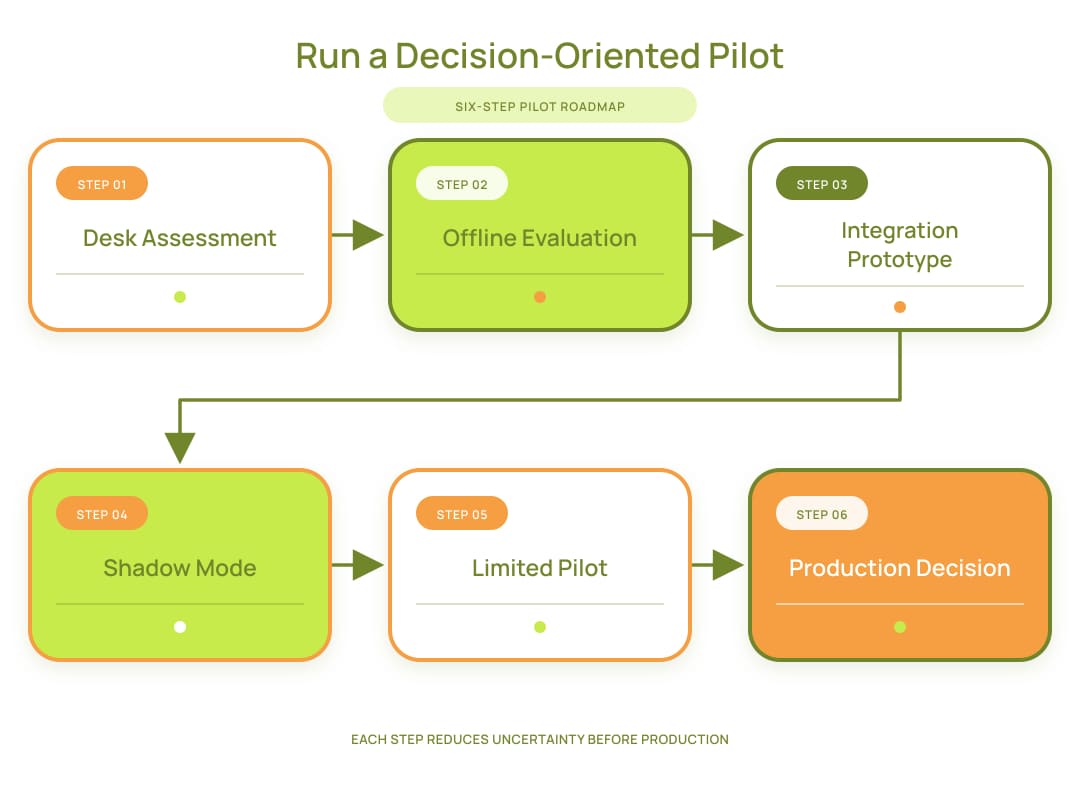
Image 1. Six-Step Decision-Oriented AI Feasibility Pilot
1. Desk Assessment
Define the use case, current baseline, data requirements, usage rights, risk tier, and initial architecture. Record the assumptions that the pilot must confirm or reject.
2. Offline Evaluation
Use a representative evaluation dataset to compare models and system configurations. Measure results against the error taxonomy, quality thresholds, latency targets, and expected cost per accepted outcome.
3. Integration Prototype
Connect the selected approach to real application programming interfaces, authentication methods, data sources, and systems of record. Test rate limits, timeouts, logging, retries, partial failures, and permission boundaries.
4. Shadow Mode
Process production-like inputs without exposing AI outputs to users or allowing the system to update business records. Shadow mode helps compare AI results with current decisions and measure quality, latency, cost, and failure patterns under realistic conditions.
5. Limited Pilot
Release the system to a restricted user group or workflow segment. Keep human review, usage limits, monitoring, incident procedures, and rollback active throughout the pilot.
6. Production Decision
Compare the results with the acceptance criteria defined in the AI feasibility assessment. Record one of three decisions: proceed to production, proceed after specified changes, or stop the use case.
The decision record should include measured quality, latency, availability, cost per accepted outcome, integration failures, human-review rate, security findings, known limitations, and unresolved risks. A blocker in a critical area should not be offset by stronger results elsewhere.
Key Takeaways
An AI feasibility assessment connects the proposed business outcome to the evidence required for a production decision. It confirms that the use case is measurable, suitable data can be used, quality thresholds are achievable, the architecture supports real operating conditions, costs remain acceptable at scale, and required controls can limit security and business risk.
The assessment should lead to a decision, not simply a working demo. If the evidence supports the use case, the team has defined conditions for production. If a critical requirement fails, the next step is to narrow the scope, change the approach, or stop further investment.
Explore Techbar’s Data & AI services to learn how our engineers support data preparation, retrieval-augmented generation, AI integration, model deployment, monitoring, and governance within existing products.

Dmytro Halkin COO
FAQs
-
How can a company determine if its data is suitable for an AI product?
The team should confirm data availability, production access, usage rights, quality, coverage, freshness, and lineage. It also needs a separate evaluation dataset with expected results validated by domain experts. Missing data rights or an unreliable source can block the use case even when model performance appears strong.
-
How should AI accuracy be evaluated before production?
Evaluation should reflect the specific task and its possible failure modes. The team should define an error taxonomy, test representative and high-risk cases, measure results across important user or data segments, and set independent thresholds for release-blocking metrics.
-
How do you calculate the operating cost of an AI feature?
Calculate the total cost of models, infrastructure, retrieval, integrations, monitoring, security, human review, and support. Divide this amount by the number of outputs that meet the acceptance criteria. This reveals the cost per accepted outcome, including retries, rejected outputs, and escalations.
-
What should an AI feasibility pilot include?
A useful pilot progresses from desk assessment and offline evaluation to an integration prototype, shadow mode, and limited release. It should use representative data, real integrations, budget limits, human review, monitoring, and rollback procedures.
-
When should an AI use case be redesigned or stopped?
Redesign or stop the use case when the outcome cannot be measured, required data cannot be used legally, acceptance thresholds remain unmet, integrations fail under realistic conditions, unit economics are unacceptable, or residual risk exceeds the approved limit. Strong results in one area should not conceal a blocker in another.