Article Highlights
- Data governance establishes decision rights, accountability, standards, processes, and controls for data throughout its lifecycle.
- A complete framework covers ownership, policies, metadata, business definitions, quality, access, security, retention, monitoring, and issue management.
- Governance requires business owners and stewards to work with technical, security, privacy, and legal teams.
- Centralized, decentralized, and federated models distribute authority differently; the right choice depends on company structure, regulation, and data maturity.
- A governance program should start with a measurable problem, one pilot domain, critical data elements, clear ownership, and baseline metrics.
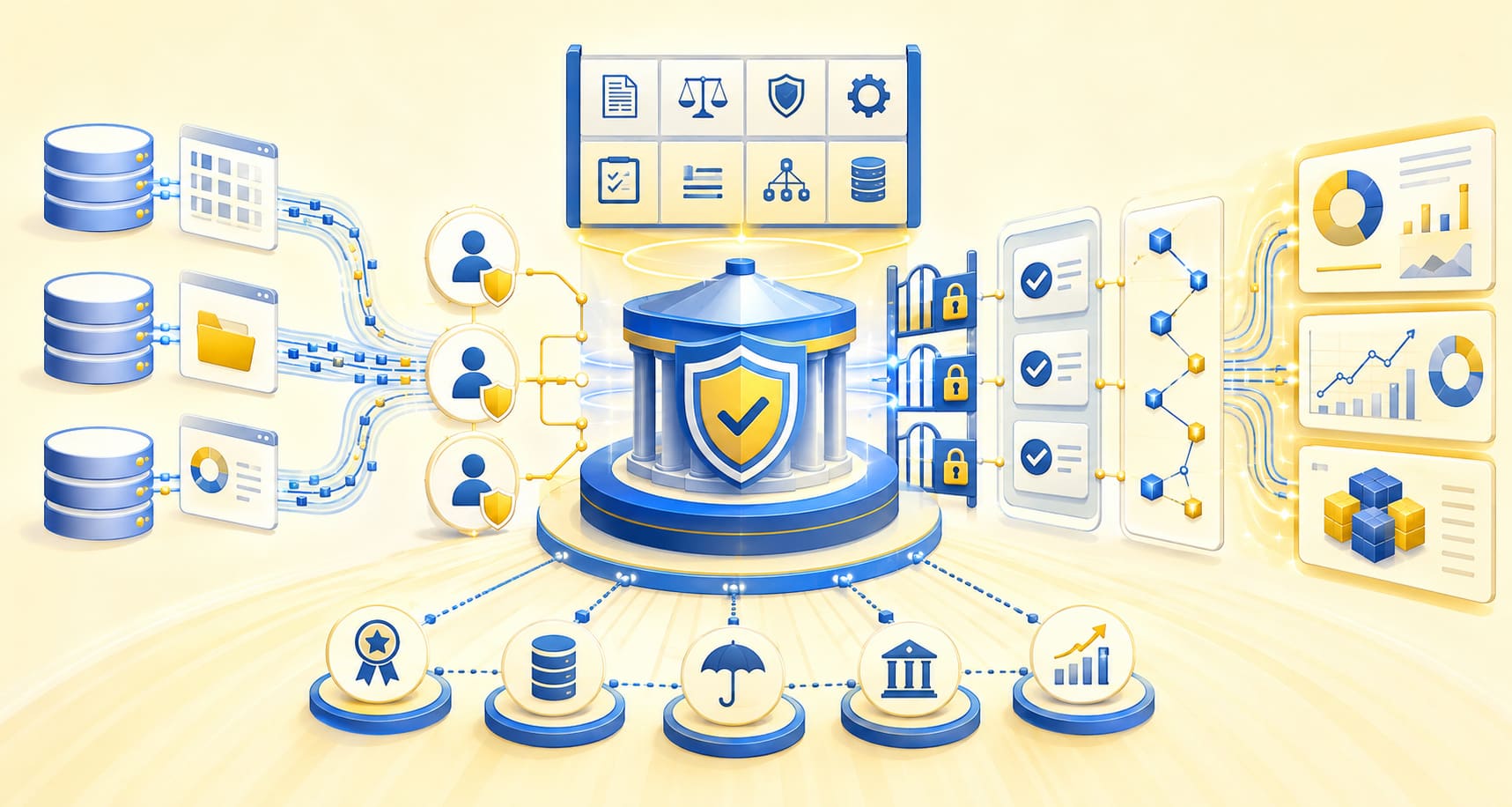
Data governance defines how an organization makes decisions about data throughout its lifecycle. It establishes decision rights, ownership, standards, processes, and controls for data that is created, collected, stored, accessed, shared, retained, and deleted.
Without a consistent data governance framework, departments can apply different definitions to the same metric, access requests can take weeks, and ownership can remain unclear. These gaps affect reporting, operational efficiency, regulatory compliance, and the ability to use data for analytics and AI.
ISO/IEC 38505-1:2026 treats the governance of data as a domain of IT governance, which is itself part of organizational or corporate governance. The standard covers the current and future use of data created, collected, stored, secured, protected, or controlled by IT systems.
Why Data Governance Matters
More Reliable Decisions
Data governance establishes approved metric definitions, accountable owners, source priorities, calculation logic, and quality expectations. This reduces time spent reconciling reports, validating results, and debating how business metrics were calculated.
Lower Operational Effort
Clear ownership and documented processes reduce duplicate datasets, repeated data cleansing, and reports built to answer the same business questions. Teams also know where to request access, report quality issues, approve changes, and escalate unresolved problems.
Controlled Access to Sensitive Data
Data governance classifies information by sensitivity and defines who can access it, for which purpose, under whose approval, and for how long. This protects personal, financial, health, and commercially sensitive data while keeping lower-risk information accessible to authorized users.
Better Collaboration
Data governance gives business, data, engineering, security, and legal teams a shared structure for working with data. Common definitions, assigned owners, and documented workflows clarify responsibilities and help teams resolve issues without passing them between departments.
Stronger Foundation for Analytics and AI
Governed datasets provide analytics and AI teams with approved sources, documented definitions, lineage, quality indicators, and permitted-use conditions. Teams can identify which data is suitable for reporting, model training, retrieval, evaluation, or inference before it enters a production workflow.
Better Regulatory Readiness
Data governance helps an organization maintain evidence of how personal and regulated data is managed. This evidence can include processing records, access approvals, retention rules, data classifications, access history, and documented policy exceptions.
The UK GDPR accountability principle requires organizations to take responsibility for their use of personal data and maintain appropriate measures and records that demonstrate compliance. Governance processes make these responsibilities, controls, and records easier to assign and maintain.
Data Governance vs. Related Disciplines
Data governance is closely connected to data management, quality, security, architecture, privacy, and metadata management, but these disciplines serve different purposes. Data governance defines who has decision-making authority, who is accountable, and which rules apply. The related disciplines provide the processes and technical capabilities required to put those decisions into practice.
| Discipline | Primary question | Example |
|---|---|---|
| Data governance | Who makes decisions about data, and which rules guide them? | A finance data owner approves the definition of recognized revenue. |
| Data management | How is data collected, stored, processed, and maintained? | An ETL pipeline transfers billing data to a data warehouse. |
| Data quality | Is the data suitable for its intended use? | Quality checks measure the completeness and validity of billing records. |
| Data security | How is data protected from unauthorized access or modification? | Encryption, masking, and identity and access management protect sensitive fields. |
| Metadata management | What does the data mean, where is it located, and who owns it? | A data catalog records definitions, owners, classifications, and technical metadata. |
| Master data management | How are core business entities kept consistent across systems? | Customer records from several applications are matched to create an agreed master record. |
| Data architecture | How are data systems, flows, and platforms organized? | Source systems feed a lakehouse, semantic layer, and BI tools through defined pipelines. |
| Privacy management | How can personal data be processed lawfully and appropriately? | Processing rules document purpose, legal basis, retention periods, and deletion requirements. |
These disciplines overlap but are not interchangeable. Data governance assigns authority, approves standards, and defines acceptable use.
When Does a Company Need Data Governance?
A company needs data governance when the complexity of its data exceeds what teams can manage through informal agreements. A major compliance failure does not need to happen first. Conflicting metrics, unclear ownership, repeated quality issues, and growing access delays are practical signs that decision rights and rules should be formalized.
Different Teams Report Different Values for the Same Metric
A metric can produce several results when departments calculate it from different sources or apply different business rules. Finance may define revenue using completed payments, Sales may use signed contract value, and a BI dashboard may report invoiced amounts. Data governance establishes an approved definition, source, calculation method, and accountable owner for each critical metric.
Employees Cannot Find Trusted Data
Teams often need governance when employees locate data through colleagues or internal messages because datasets lack descriptions and ownership. Several reports may have similar names, with no indication of which version is current. Analysts then spend time validating existing data or recreating datasets that already exist.
Access Is Uncontrolled or Too Slow
Access problems can appear in two forms: sensitive data is available too broadly, or every request follows the same lengthy approval process. A data governance framework classifies data by sensitivity and defines separate approval paths for low-risk, confidential, and restricted datasets.
Data Quality Incidents Keep Returning
Repeated corrections in reports or downstream tables indicate that teams are treating the result of a data problem without addressing its source. Governance assigns responsibility for investigation, defines quality thresholds, and establishes how recurring issues are escalated and resolved.
The Data Estate Is Expanding
New SaaS systems, cloud migration, acquisitions, multiple business units, external data sharing, and self-service analytics increase the number of sources, owners, dependencies, and access paths. A warehouse or lakehouse implementation also requires shared rules for naming, ownership, quality, metadata, and permitted use.
At this stage, governance should be designed together with the company’s data architecture and delivery processes. Techbar’s Data & AI service covers data platforms, pipelines, analytics, quality, compliance, and AI solutions that can support the technical implementation of these rules.
Audits or Regulations Require Evidence
Governance becomes necessary when a company must demonstrate who can access data, why personal data is collected, how long records are retained, who approved processing, which controls are active, and how incidents are handled. Defined ownership and documented workflows help produce this evidence consistently instead of reconstructing it during each audit or regulatory request.
Do not respond to these signals by introducing company-wide governance for every dataset at once. Begin with critical data domains, regulated information, high-impact metrics, or a specific business problem. An overly broad first scope can create unnecessary approval steps and documentation without resolving the issues that prompted the program.
What Does a Data Governance Framework Include?
A data governance framework connects business objectives with ownership, policies, definitions, quality rules, access controls, lifecycle requirements, and monitoring. It defines how decisions are made and how they are applied through operational processes and technical controls.
1. Strategy and Scope
The framework should define the business problems it addresses, the data domains covered, the main risks, target users, regulatory requirements, and success metrics. A focused scope helps the organization prioritize critical data instead of applying the same governance effort to every dataset.
2. Ownership and Decision Rights
Critical data should have defined business ownership, stewardship, technical responsibility, approval authority, and escalation paths.
3. Policies and Standards
Policies establish consistent requirements for data classification, access, quality, metadata, retention, deletion, sharing, changes, incidents, and exceptions. They should state what is required, who approves decisions, and how compliance is verified.
Data contracts can support these policies by documenting the structure, meaning, quality expectations, ownership, and change rules for data exchanged between producers and consumers.
4. Metadata and Business Definitions
A catalog should record where data is stored, how it moves between systems, who owns it, and how it is classified. A business glossary should document approved terms, metric definitions, calculation logic, and usage conditions. Together, technical and business metadata help users find data and understand whether it is appropriate for a specific purpose.
5. Data Quality
Quality requirements should reflect the intended use of the data. A dataset may be sufficient for trend analysis but unsuitable for regulatory reporting or automated decisions.
Common dimensions include accuracy, completeness, consistency, timeliness, validity, and uniqueness. The UK Government Data Quality Hub recommends selecting the dimensions that determine whether data is fit for its intended purpose rather than applying every measure equally.
6. Access, Privacy, and Security
The framework should classify data by sensitivity and define who can access it, for which purpose, under whose approval, and for how long. It should also establish access reviews, monitoring requirements, and conditions for sharing data with third parties.
7. Lifecycle Management
Data governance applies from data creation or collection through active use, sharing, archival, retention, legal hold, and deletion. Lifecycle rules help prevent data from being retained without a business or legal reason and ensure that required records remain available for the appropriate period.
8. Monitoring and Issue Management
Governance metrics should show whether ownership, quality, access, metadata, and policy requirements are working as intended. The framework should define issue severity, remediation owners, escalation paths, approved exceptions, review dates, and the evidence retained for audits.
Data Governance Roles and Responsibilities
A data governance framework requires clear responsibilities across business, data, technology, security, privacy, and legal teams. Job titles can differ between organizations, but authority, accountability, and escalation paths should remain explicit.
| Role | Area of responsibility |
|---|---|
| Executive sponsor | Provides authority, funding, and alignment with business priorities. This role may belong to a CDO, CIO, CTO, or another executive responsible for the relevant business area. |
| Data governance council | Resolves cross-domain conflicts, approves enterprise definitions and priorities, reviews major exceptions and regulatory risks, and monitors program performance. |
| Domain data owner | Is accountable for the business meaning, approved use, quality priorities, access decisions, lifecycle rules, and major changes within a specific data domain. |
| Data steward | Maintains glossary terms, metadata, classifications, and quality information. Coordinates issue resolution between owners, producers, technical teams, and consumers. |
| Data product owner | Manages a packaged dataset or analytical product, including its users, documentation, quality, availability, and development priorities. |
| Technical custodian or platform team | Manages data platforms, storage, pipelines, catalog integrations, access mechanisms, monitoring, and technical enforcement of data governance policies. |
| Security, privacy, and legal teams | Interpret applicable requirements and review high-risk processing, external sharing, controls, incidents, and policy exceptions. |
| Data consumer | Uses data for approved purposes, follows access and handling requirements, considers documented limitations, and reports identified issues. |
Microsoft’s guidance for governance planning recommends involving data owners, data stewards, and knowledgeable business users from the beginning, with IT teams acting as technical partners. This structure keeps business decisions with the people who understand the data and gives technical teams clear requirements for implementation.
Data Governance Models
A data governance model determines where decision-making authority sits and how responsibilities are divided between a central team and business domains. The appropriate model depends on the organization’s size, structure, regulatory obligations, data complexity, and governance maturity.
Centralized Model
In a centralized model, one team defines standards, business terms, access rules, and oversight processes across the organization. This approach can work well for companies with a limited number of data domains, smaller data estates, strict regulatory requirements, or an early-stage data governance program.
Central control can improve consistency but may also create approval bottlenecks. A central team may lack the context required to address domain-specific definitions, quality expectations, and local priorities quickly.
Decentralized Model
A decentralized model gives business domains authority over their own data, definitions, access decisions, and quality requirements. It can suit companies with autonomous products, independent business units, or distinct customer and operational contexts.
The main risk is inconsistency across the organization. Domains can create conflicting definitions, duplicate standards, apply security requirements differently, and make enterprise reporting more difficult.
Federated Model
A federated model combines enterprise-wide standards with domain-level ownership. A central team defines shared classification rules, privacy and security requirements, minimum metadata, audit processes, and common platform capabilities. Domain teams manage business definitions, data quality, product documentation, access decisions, and consumer support within those boundaries.
This model is often a practical choice for medium-sized and large organizations because it maintains common controls without requiring a central team to approve every decision. It still requires clear boundaries between central and domain authority; otherwise, responsibility can become unclear or the model can revert to centralized approval.
Data Mesh
Data mesh is an organizational and architectural approach rather than a complete replacement for a data governance framework. It assigns ownership of data products to business domains, supported by a self-service platform and federated governance.
Google Cloud describes four core data mesh principles: domain-oriented ownership, data as a product, self-service data infrastructure, and federated computational governance. This approach requires domain teams to have sufficient data engineering and governance skills, so it is better suited to complex organizations that can support distributed ownership.

How to Start a Data Governance Program
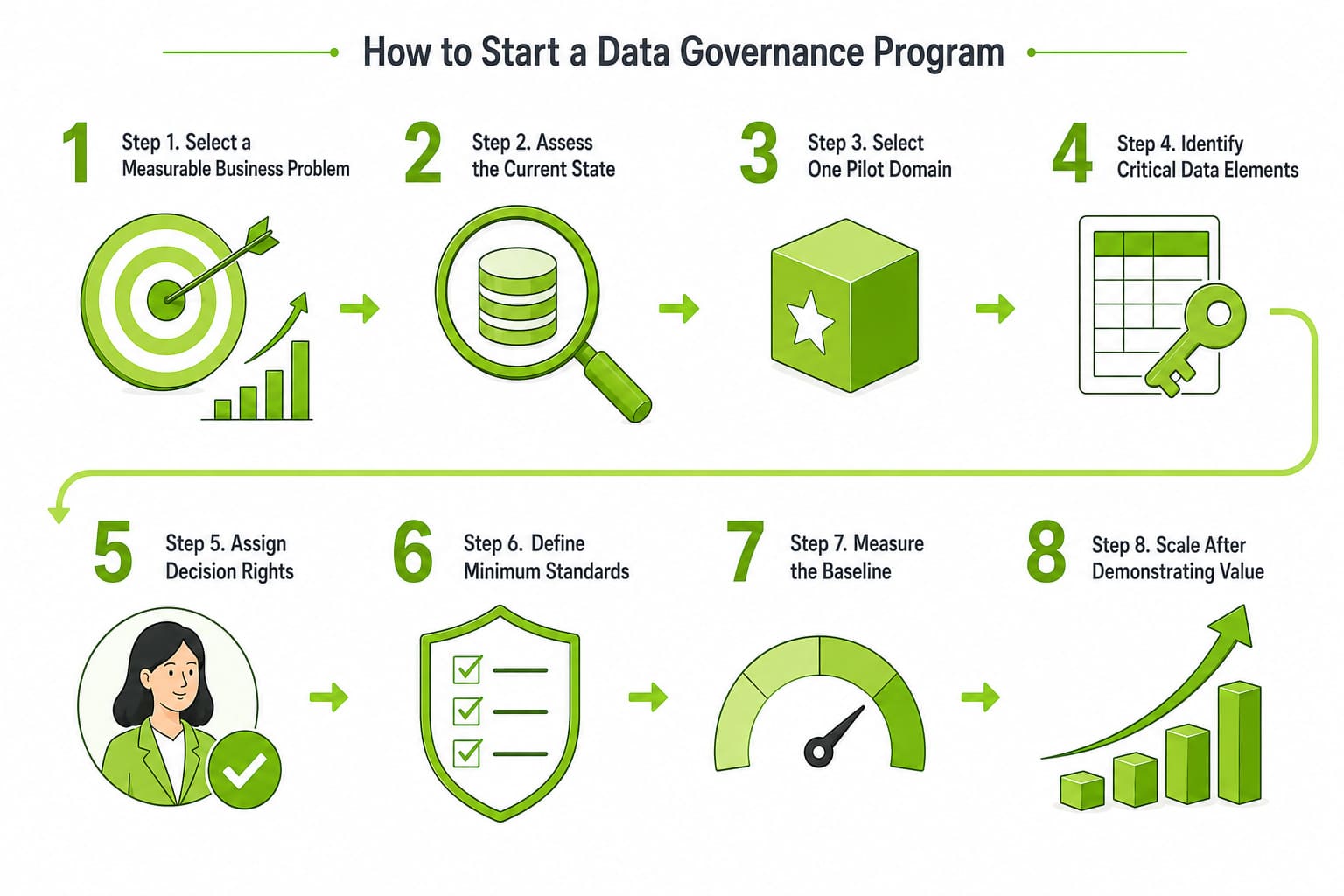
A data governance program should begin with a measurable business problem and a limited scope. This gives the organization a clear reason for the work, reduces implementation risk, and makes its effect easier to evaluate.
Step 1. Select a Measurable Business Problem
Choose a specific problem such as conflicting revenue metrics, slow access to customer data, repeated quality incidents, an AI initiative without approved datasets, or unresolved audit findings. Define the expected improvement before introducing new roles, policies, or tools.
Step 2. Assess the Current State
Map the critical data sources, known owners, recurring problems, access procedures, existing definitions, policies, regulatory requirements, and current tools. This assessment shows which governance capabilities already exist and where ownership or controls are missing.
Step 3. Select One Pilot Domain
Choose a domain with clear business value, known users, identifiable owners, a manageable number of systems, and a measurable problem. Finance, customer, product, or operational data can serve as a pilot when the scope is narrow enough to manage.
Step 4. Identify Critical Data Elements
Apply the strongest governance effort to data that affects executive reporting, customer identification, financial operations, regulated records, AI inputs, or business-critical processes. Managing every field at the same level adds work without producing equal value.
Step 5. Assign Decision Rights
Document the owner, steward, technical custodian, approver, escalation path, and responsibility for resolving issues. Each participant should know which decisions they can make and which require review by another role or governance body.
Step 6. Define Minimum Standards
For the pilot domain, establish approved definitions, classifications, access conditions, quality requirements, metadata, retention rules, and an issue-management process. These standards should be specific enough to guide daily decisions and technical implementation.
Step 7. Measure the Baseline
Record the current time required to approve access and resolve data issues, along with the number of metric disputes, quality incidents, manual corrections, and undocumented assets. Without a baseline, the organization cannot demonstrate the effect of data governance or identify which parts of the program need adjustment.
Step 8. Scale After Demonstrating Value
Expand the program after the pilot produces measurable results. The next phase can cover additional domains, a broader catalog, automated quality controls, self-service access, data products, and policy automation. Apply the tested ownership model and standards while adapting them to the needs of each new domain.
Key Takeaways
Data governance defines who can make decisions about data, who is accountable for the outcome, which standards apply, and how those standards are enforced. It connects business ownership with data quality, metadata, access, security, lifecycle management, and audit evidence.
The governance model should reflect the organization’s size, structure, regulatory context, and data maturity. Centralized governance can support smaller or highly regulated environments, while a federated model often suits growing companies that need shared enterprise rules and domain-level ownership.
A data governance program should begin with one measurable business problem and a pilot domain. Clear decision rights, minimum standards, and baseline metrics allow the company to demonstrate value before expanding governance to additional data domains.
Explore TechBar’s Data & AI services to learn how our engineers can support data architecture, pipelines, quality, access controls, compliance, analytics, and AI initiatives. To discuss your current data challenges and governance requirements, contact TechBar.

Dmytro Barbashov CTO
FAQs
-
What is the main purpose of data governance?
The main purpose of data governance is to define how decisions about data are made and who is accountable for them. It establishes common rules for data meaning, quality, access, security, use, retention, and issue resolution.
-
What is included in a data governance framework?
A data governance framework includes strategy, scope, ownership, decision rights, policies, business definitions, metadata, quality requirements, access controls, lifecycle rules, monitoring, and issue management. It also defines how compliance is verified and how exceptions are approved.
-
Who is responsible for data governance?
Responsibility is distributed across several roles. Executive sponsors provide authority, data owners make business decisions, stewards maintain definitions and coordinate issues, and technical teams implement the required controls. Security, privacy, legal teams, product owners, and data consumers also have defined responsibilities.
-
Which data governance model is best for a growing company?
A federated model is often suitable for a growing company with several business or data domains. A central team defines shared standards and controls, while domain teams manage definitions, quality, documentation, and access decisions for their own data. The final choice should reflect the company’s structure, regulatory obligations, and available domain expertise.
-
How should a company start a data governance program?
Start with a measurable problem such as conflicting metrics, slow access approvals, recurring quality incidents, audit findings, or missing controls for AI data. Select one pilot domain, identify its critical data elements, assign decision rights, define minimum standards, and record baseline metrics before making changes.